



Panhard Dyna Z: the light saloon that dared another route
Built from 1954 to 1959, the Dyna Z is one of the clearest examples of the Panhard method: light construction, aerodynamic work, front-wheel drive and a small flat twin used with precision.
 \n
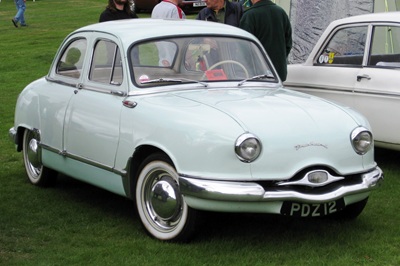
\nIn the French car industry of the 1950s, the Panhard Dyna Z occupies a very particular place. It did not rely on a large engine, heavy decoration or the reassuring habits of a conventional family saloon. Its argument was more precise: go quickly enough, carry a family properly and consume little by keeping weight and drag under control.
Presented in 1953 and produced from 1954, the Dyna Z replaced the Dyna X with a larger, smoother and more mature car. The formula remained unmistakably Panhard: an air-cooled flat twin, front-wheel drive, an advanced body shape and a constant search for efficiency.
A body shaped by efficiency
The Dyna Z was drawn by Louis Bionier, and its silhouette still looks unusual today. The front is rounded, the sides are clean and the whole car has the soft continuity of a shape studied in the air. This was not only a stylistic choice. Panhard needed the body to help the engine, not to fight it.
The earliest cars used Duralinox, an aluminium alloy that made the saloon very light for its size. That choice gave the Dyna Z excellent liveliness, braking and economy, but it was costly to produce. During the model's life, Panhard moved progressively from aluminium to mixed construction and then to steel. The cars became heavier, but the engineering idea stayed visible.
The flat twin and the road feel
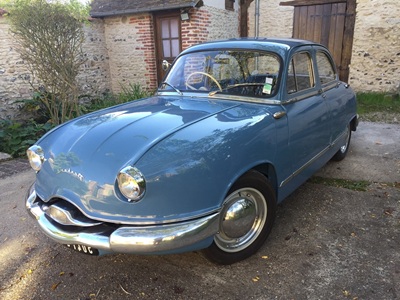
Under the bonnet, the Dyna Z used an 851 cc air-cooled opposed twin-cylinder engine. On paper, the figures look modest. On the road, the interest lies in the whole package: low weight, front-wheel drive, a four-speed gearbox and a body that does not waste too much energy in the air.
The engine gives the car a sound of its own. It is not a silent, anonymous saloon. The driver hears the mechanics, feels the lightness and learns the rhythm of the gear change. A Dyna Z is not difficult in a brutal way, but it asks for a little attention. That is part of its appeal today.
Dyna Z1, the purest phase
The Z1 is often remembered as the most faithful expression of the original concept. Built from 1954, it made the most of aluminium construction and kept the weight very low. In that form, the Dyna Z could reach useful cruising speeds without needing a large engine. It also gave Panhard a strong image as a manufacturer willing to think differently.
This same solution also created a problem. Aluminium was excellent for lightness, but difficult and expensive in production. The gradual arrival of steel was not a betrayal of the idea so much as an industrial necessity. The later cars lost some sharpness, but they made the range viable for a few more years.
Versions from 1954 to 1959
The Dyna Z range evolved quickly, and the names can be confusing. The main saloon versions include the early Z1, the simpler Z11 and the better finished Z12, while the Z16 introduced further chassis changes and could receive the Tigre engine. Cabriolets and utility derivatives also existed, which shows how far Panhard tried to stretch the same basic design.
- Z1, 1954-1956: the early light saloon, closely linked to the aluminium concept.
- Z11, 1956-1959: a simpler steel-bodied saloon in the heart of the range.
- Z12, 1956-1958: a better trimmed saloon, offered as Luxe Spécial, Grand Luxe or Grand Standing depending on year and finish.
- Z16, 1958-1959: a later evolution with improved running gear and, on some cars, the Tigre option.
- Z15 and Z17: cabriolet versions, rarer and more sought after today.
- W2 and D-65: utility versions, including pick-up and van derivatives.
Technical points to remember
- Engine: air-cooled flat twin, 851 cc.
- Power: about 42 hp in standard versions, up to around 50 hp with Tigre specification.
- Transmission: front-wheel drive, four-speed manual gearbox with column shift.
- Suspension: independent wheels, with solutions typical of Panhard's lightweight thinking.
- Brakes: hydraulic drums on all four wheels.
- Weight: roughly 710 to 875 kg depending on year, body material and finish.
- Top speed: commonly around 125 to 130 km/h for standard 42 hp cars.
These figures should be read with care because the Dyna Z changed during production. They still explain the model well. The car is not about one spectacular number, but about the balance between small displacement, light construction and carefully managed aerodynamics.
Why collectors still notice it
The Dyna Z attracts people who like engineering choices that can be seen and felt. Its rounded front, its central visual balance and its unusual sound give it a strong presence. More importantly, it tells a story of a small French manufacturer trying to solve family-car problems in its own way.
Good examples deserve careful identification. Body material, year, finish, engine type and completeness all matter. A Dyna Z can be charming even in imperfect condition, but its technical originality means that documentation, clubs and specialist knowledge are valuable allies. Preserved with care, it remains one of the most distinctive French saloons of the 1950s.
To place the Dyna Z in context, you can also read our Dyna Z12 in the Gulf of Saint-Tropez, along with the Dyna from Panhard.
Sources
Documents
- Panhard Dyna Z - history, production, versions and model evolution
- Panhard Dyna Z - historical and technical overview
- Automobile Catalog - technical data and Dyna Z versions
- Panhard Belgique - technical characteristics and comparative data
- News d'Anciennes - historical context and Dyna Z evolution
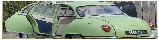
- Intro image: Panhard Dyna Z 851 cc, 1958 model year
