


Mercedes-Benz SLK: from the birth of the retractable hardtop roadster to the end of the lineage
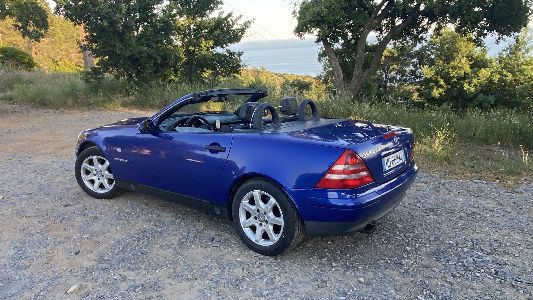
The Mercedes-Benz SLK holds a unique place in contemporary automotive history. When it appeared in the mid-1990s, it did more than simply add a small roadster to the Mercedes-Benz range: it redefined the segment by popularizing what was then a highly bold architecture, that of the retractable hardtop coupé-convertible. Compact, prestigious, technically accomplished, and more versatile than a classic soft-top roadster, the SLK quickly became a benchmark.
From its gestation as a concept in the early 1990s to its transformation into the SLC in 2016, and then the end of the line with the Final Edition series, the SLK followed a consistent trajectory: bringing the spirit of the Mercedes roadster into a more compact, more accessible, and more practical everyday format, without giving up the brand’s characteristic technical rigor [1][2][3][4].
A simple idea in appearance, complex in reality
The name SLK alone sums up the philosophy of the model. At Mercedes-Benz, it refers to the idea of a car that is Sportlich, Leicht, Kurz — sporty, light, short. This definition is not just a communication slogan: it genuinely shaped the original design brief. Mercedes wanted to offer a compact roadster capable of retaining the level of safety, comfort, and perceived quality expected of a production Mercedes, while still delivering a true open-air driving experience.
The project took on decisive importance in 1994. That year, Mercedes presented a near-production study, followed by an evolution equipped with the future key element of the program: the vario-roof, an electrohydraulic retractable hardtop folding into the trunk. Presented at the 1994 Paris Motor Show, this system completed its operation in 25 seconds while preserving residual luggage space, which at the time constituted a major technical and commercial argument [1].
This choice profoundly changed the nature of the vehicle. Where a traditional roadster imposes a marked compromise between insulation, passive safety, winter usability, and summer driving pleasure, the future SLK aimed to be two cars in one: a small rigid coupé when closed, a roadster when open. From an engineering standpoint, this required a particularly well-designed body structure, a reliable roof mechanism, a trunk design compatible with the folding roof, and precise weight management in a car with compact dimensions.
First generation R170 (1996-2004): the SLK that created the modern concept
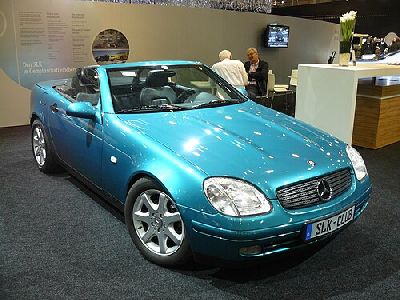
The SLK R170 was unveiled in production form in spring 1996 and marketed that same year. From the outset, it stood out from its competitors thanks to a very rational positioning: rear-wheel drive, strict two-seat layout, compact dimensions, and a retractable metal roof. More than its raw technical specifications, it was this combination that made it successful [2].
The vario-roof as a technological signature
On the R170, the retractable hardtop was not a gimmick; it was the keystone of the project. Its steel structure transformed the car’s usability. When closed, the SLK offered a level of sound insulation, safety, and weather protection superior to that of a roadster with a fabric roof in the same category. When open, it retained the silhouette and purity of a classic roadster. The complete roof operation took 25 seconds [2].
Highly developed safety for a small roadster
Mercedes did not treat the SLK as a simple pleasure car. The structure received very robust fixed rollover bars behind the seats, combined with reinforced windshield pillars. The car featured front airbags, seat-belt pretensioners, and belt-force limiters; side airbags were also available. Mercedes also introduced an ellipsoid bulkhead at the front, designed to improve controlled deformation and better preserve legroom in the event of a frontal impact [2].
Engines consistent with the model’s positioning
The first SLK relied heavily on supercharged four-cylinder engines KOMPRESSOR, especially the SLK 200 and 230. Mercedes promoted the mechanical supercharger to achieve strong torque at low and mid-range revs, better suited to road use than a highly tuned naturally aspirated small-displacement engine. The SLK 200 KOMPRESSOR and 230 KOMPRESSOR respectively delivered up to 270 Nm and 280 Nm, with already solid performance for the era, while the naturally aspirated SLK 200 remained the more modest entry point to the range [2].
The 2000 facelift: reaching maturity
In 2000, the R170 evolved significantly. Mercedes notably generalized ESP, added a 6-speed manual gearbox, increased fuel tank capacity, and revised the chassis with new suspension settings and reinforced anti-roll bars. This was also when the SLK 320 with a V6 engine arrived, bringing more torque and smoothness to the range, as well as the SLK 32 AMG, the model’s first true high-performance interpretation [3].
Technical assessment of the R170
The first generation laid all the foundations of the line: retractable hardtop, high structural safety, rear-wheel drive, supercharged or V6 engines, and everyday versatility. It did not seek to be the most radical car in the segment; it sought to be the smartest. This approach largely explains its commercial success. Mercedes states that by the end of the R170’s career, total sales had reached 311,222 units, proof that the formula appealed well beyond the circle of convertible enthusiasts [3].
Second generation R171 (2004-2010): the phase of industrialization and refinement
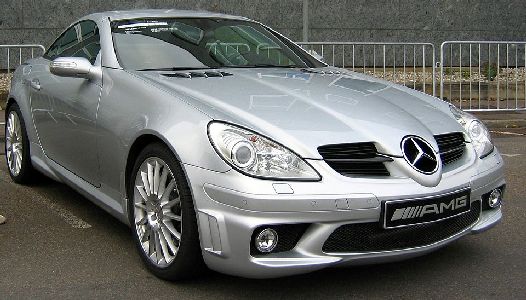
Presented at the 2004 Geneva Motor Show, the SLK R171 did not break away from the R170; it industrialized it at a higher level. The styling became sharper, more muscular, and more inspired by Mercedes’ larger sports cars. Dimensions increased, with a longer wheelbase and a longer body, improving visual presence, road stance, and practical roominess at the same time [4].
More advanced aerodynamics and structure
Mercedes worked on body rigidity, underbody aerodynamics, and overall balance. The vario-roof also evolved: its kinematics were optimized, its packaging in the trunk was reduced, and the operation time dropped to 22 seconds. Above all, the available luggage volume with the roof folded improved significantly, further strengthening the model’s versatile character [5].
The invention of AIRSCARF
The R171 marked one of the segment’s greatest comfort innovations with AIRSCARF. This neck-level heating system integrated into the seatbacks blows warm air around the head and neck area. The idea was simple but highly effective: extending the open-top driving season and making the roadster more usable in cooler conditions. Introduced as an option on the R171, this innovation would become one of the model’s distinguishing features [5].
More technology, more sportiness, more AMG
The R171 moved notably upmarket. Lighting improved, equipment became richer, sound insulation in the closed configuration came closer to that of a coupé, and active safety continued to evolve. The AMG range also expanded: the SLK 55 AMG installed a V8 in the small roadster, while the highly radical SLK 55 AMG Black Series pushed the concept toward an almost track-focused interpretation, even if it differed technically and philosophically from the core range.
The 2008 facelift: rationalization and continuous improvement
From 2008 onward, Mercedes carried out a major update of the model with around 650 newly developed components. The car evolved in styling, equipment, and tuning. In 2009, the naming logic changed in the range with the transformation of the SLK 280 into the SLK 300 in certain markets. In total, Mercedes states that around 242,000 units of the R171 were produced between 2004 and 2010, confirming the success of a car nevertheless positioned in a niche segment [6].
What the R171 really changed
The second generation transformed the SLK into a fully mature product. Where the R170 initially innovated through its concept, the R171 added a layer of sophistication: better rigidity, a more upscale interior, improved aerodynamic efficiency, comfort innovations dedicated to open-top driving, and the rise of the AMG branch. It is probably the generation that best balanced driving pleasure, compactness, prestige, and daily usability.
Third generation R172 (2011-2015): efficiency, driver assistance, and technical sophistication
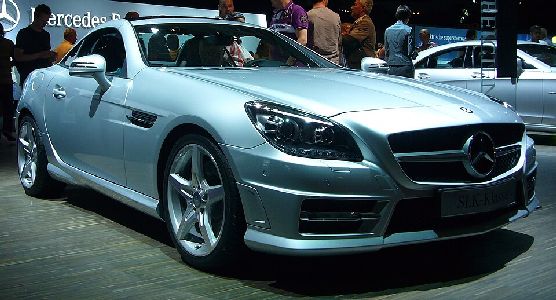
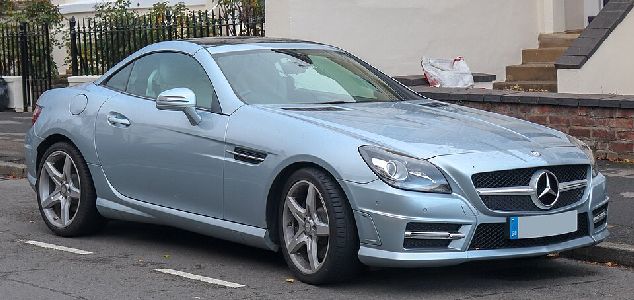
The SLK R172, presented in early 2011, opened a new phase. The design moved visually closer to the larger Mercedes models of the period, with a more sculpted front end and a more prestigious appearance. But the most important development was less stylistic than conceptual: the SLK became a more technological, more efficient compact roadster, better aligned with modern standards of safety and driver assistance systems [7].
An optimized body and an even more advanced roof
The structure retained the high-safety principle characteristic of the line, but with a lighter design. Mercedes notably pointed to the use of aluminum front fenders and hood, reduced body weight, and improved torsional rigidity. The drag coefficient dropped to 0.30, reflecting real aerodynamic efficiency work [8].
The vario-roof continued to mature. Its kinematics were lightened through the use of aluminum and magnesium elements, and its opening/closing time dropped to under 20 seconds. Above all, Mercedes introduced on this generation a striking solution: MAGIC SKY CONTROL, an electrically controlled variable-tint glass roof. Presented as a world first for this type of equipment, this technology made it possible to modulate light transmission on demand [8].
Engines: the search for efficiency without giving up performance
The R172 perfectly embodied the period when Mercedes sought to reconcile performance, emissions, and fuel consumption. The range-topping launch model was the SLK 350 BlueEFFICIENCY, powered by a 3.5-liter V6 producing 306 hp and 370 Nm, capable of 0 to 100 km/h in 5.6 seconds, while still posting restrained standardized fuel consumption for its level of performance [9].
The four-cylinder range also evolved in the direction of overall optimization: direct injection, finer electronic management, friction-reduction measures, ECO start/stop function, and 7G-TRONIC PLUS transmission on certain versions. The SLK thus became less mechanically demonstrative than some pure sports cars, but more relevant from an industrial and regulatory standpoint.
The very special case of the SLK 250 CDI
In 2011, Mercedes took a step that would have seemed unlikely a few years earlier: offering a diesel SLK for the first time. The SLK 250 CDI BlueEFFICIENCY received a 2.2-liter biturbo four-cylinder engine producing 204 hp and, above all, 500 Nm. The figures reveal the logic behind the project: a top speed of 243 km/h, 0 to 100 km/h in 6.7 seconds, and standardized fuel consumption of 4.9 l/100 km according to the NEDC standard in force at the time [10].
This version was not merely a commercial curiosity; it showed how far Mercedes pushed the idea of the SLK as a roadster usable every day. Diesel was never the most emotional expression of the line, but it was one of the clearest demonstrations of its technical rationality.
The top of the range: SLK 55 AMG
The SLK 55 AMG of the R172 generation represented the mechanical pinnacle of the SLK family. Its naturally aspirated 5.5-liter V8 developed up to 421 hp in Mercedes Classic documentation, with 0 to 100 km/h in 4.6 seconds. Mercedes also highlighted the use of selective cylinder deactivation under partial load to improve efficiency, illustrating well the philosophy of the period: preserving the nobility of the V8 while meeting modern constraints [8].
An SLK increasingly “Mercedes”
The R172 also stood out through the arrival of technologies previously reserved for higher segments: driver aids, improved lighting systems, enhanced multimedia interfaces, more refined interior presentation, and more numerous comfort options. Technically, the car therefore moved away from the minimalist roadster and became a highly complete premium compact roadster.
2016: from SLK to SLC, a name change more than a break in concept
In 2016, Mercedes changed the commercial designation of the line: the SLK became the SLC. This change was part of the brand’s new naming logic, with the model positioned more clearly as a compact roadster commercially related to the C-Class. The technical base remained that of the R172, but in a facelifted and updated form [11].
The name change should therefore not be interpreted as the birth of an entirely new model. From an industrial standpoint, it was indeed the continuation of the third generation, modernized and renamed. In other words, the final phase of the SLK’s career took place under the SLC designation.
The end of the line: Final Edition and the conclusion of the lineage
The end of the journey was marked by the SLC Final Edition, announced by Mercedes-Benz as the model’s final flourish. This special series sealed the conclusion of a lineage that had begun in 1996. It served as a reminder of how important the SLK concept had been within the Mercedes offering: for nearly a quarter of a century, the brand maintained a unique proposition combining compact dimensions, rear-wheel drive, a retractable hardtop, and a high level of safety and finish [12].
With the discontinuation of the SLC, Mercedes brought to an end not only a model, but also a certain idea of the premium compact roadster. The market had changed: stricter regulations, a structural decline in demand for compact coupé-convertibles, the rise of SUVs, and the industrial repositioning of manufacturers. The disappearance of the SLK/SLC was therefore both a product fact and a symptom of changes in the automotive market.
Technical analysis: why the SLK mattered
1. It democratized the modern premium coupé-convertible
The SLK did not invent the retractable roof in the absolute sense of automotive history, but it was one of the models that made it desirable, reliable, and industrially credible in the modern era. Its vario-roof played a decisive role in the spread of the premium compact coupé-convertible concept.
2. It shifted the balance between pleasure and real-world usability
The genius of the SLK lies in its compromise. Many roadsters are enjoyable but constraining. The SLK, by contrast, always sought to be easier to live with: better insulation, better safety, genuine winter usability, usable trunk space, long-distance comfort, higher-end equipment, and innovations designed for open-top driving. It is precisely this synthesis that defined its identity.
3. It served as a laboratory for several meaningful innovations
From the electrohydraulic retractable hardtop to AIRSCARF, and later MAGIC SKY CONTROL, the SLK regularly served as a platform for distinctive technical solutions. Unlike certain technological showcases with no future, these solutions had direct usefulness for the customer experience.
4. It managed to remain consistent despite changing times
The R170 was the pioneer of the concept. The R171 brought product maturity. The R172 went further in efficiency, assistance systems, and technical sophistication. Despite these changes, the guiding principle never really disappeared: to create an open Mercedes that was compact, technically serious, rewarding, and usable all year round.
What place does the SLK hold today?
With hindsight, the SLK appears as one of the most representative models of Mercedes-Benz engineering from the late twentieth and early twenty-first centuries. It was neither the most extreme, nor the lightest, nor the purest of sports cars. On the other hand, it was one of the most intelligently designed in its category.
For the automotive enthusiast, each generation now has a distinct appeal:
- R170: the original, pioneering, emblematic of the coupé-convertible boom.
- R171: the most balanced, often regarded as the most homogeneous in style, driving appeal, and technical maturity.
- R172: the most modern, the most technological, and in 55 AMG form, the most mechanically spectacular.
Ultimately, the SLK will remain a car of synthesis. A car capable of uniting qualities that are often seen as opposites: compactness and comfort, pleasure and rationality, elegance and safety, technology and everyday usability. That is precisely why it left a lasting mark on the European automotive landscape.


Sources
- Concept SLK à toit repliable présenté à Paris en 1994 [1]
- Mercedes-Benz SLK R170 (1996-2000), archives officielles [2]
- Mercedes-Benz SLK R170 restylée (2000-2004), archives officielles [3]
- Mercedes-Benz SLK R171 (2004-2008), archives officielles [4]
- Mercedes-Benz SLK R171 : vario-roof 22 s et AIRSCARF [5]
- Mercedes-Benz SLK R171 restylée (2008-2010), archives officielles [6]
- Mercedes-Benz SLK R172 (2011-2015), archives officielles [7]
- Mercedes-Benz SLK R172 : MAGIC SKY CONTROL, V8 AMG et aérodynamique [8]
- Mercedes-Benz SLK 350 BlueEFFICIENCY : données moteur et performances [9]
- Mercedes-Benz SLK 250 CDI BlueEFFICIENCY : diesel, couple et consommation [10]
- Documentation officielle Mercedes-Benz SLC Roadster (2016) [11]
- Annonce officielle Mercedes-Benz SLC Final Edition [12]