







Mercedes-Benz : de la naissance de l’automobile aux grandes innovations de la marque
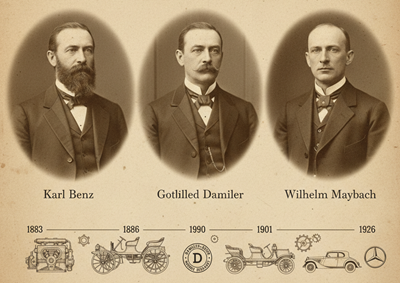
Mercedes-Benz n’est pas une marque apparue d’un seul bloc. Son histoire rassemble les travaux de Karl Benz, de Gottlieb Daimler et de Wilhelm Maybach, puis l’apprentissage industriel d’un constructeur qui a souvent utilisé la route comme laboratoire. De la Mercedes 35 PS au Diesel de série, des carrosseries de sécurité à l’électrification, la marque a bâti sa réputation en transformant des démonstrations techniques en solutions diffusées à grande échelle.
Aux origines : Benz, Daimler, Maybach
À la fin du XIXe siècle, l’automobile n’existe pas encore comme industrie stabilisée. On trouve des moteurs fixes, des expérimentations, des voitures à cheval transformées et des inventeurs qui cherchent surtout à rendre leurs machines utilisables hors du laboratoire. Chez Mercedes-Benz, cette préhistoire compte autant que la suite, car la marque est née de plusieurs essais menés en parallèle plutôt que d’un récit unique et parfaitement linéaire.
Karl Benz et le Patent-Motorwagen
En janvier 1886, Karl Benz dépose le brevet du Patent-Motorwagen. Le choix de trois roues n’a rien d’anecdotique : il lui permet de contourner un problème encore mal résolu, celui d’une direction fiable sur quatre roues. Avec son monocylindre à essence monté à l’arrière, cette machine ne ressemble pas encore à l’automobile classique du XXe siècle, mais elle pose un principe décisif : un véhicule conçu dès l’origine autour d’un moteur autonome et non comme un simple attelage modifié.
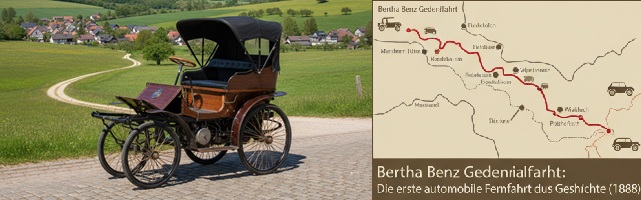
Deux ans plus tard, Bertha Benz donne à l’invention sa première démonstration publique réellement convaincante. Son trajet entre Mannheim et Pforzheim, effectué en août 1888, montre qu’un véhicule à moteur peut couvrir plus de cent kilomètres, être réparé en chemin, ravitaillé et conduit dans des conditions réelles. Ce voyage vaut presque autant qu’un brevet : il prouve l’usage.
Daimler, Maybach et le moteur léger
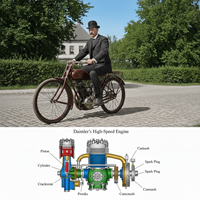
Au même moment, Gottlieb Daimler et Wilhelm Maybach suivent une autre voie. Leur obsession n’est pas seulement la voiture, mais le moteur rapide, compact et adaptable à plusieurs usages. La Reitwagen de 1885, puis les moteurs montés sur des embarcations et sur des voitures, montrent cette logique : alléger, accélérer, simplifier, rendre la motorisation suffisamment souple pour s’installer sur terre, sur l’eau et, bientôt, dans les airs.
C’est là que se dessine déjà une partie de l’identité future de Mercedes. L’étoile à trois branches ne renvoie pas d’abord au prestige ; elle renvoie à cette ambition technique de motoriser plusieurs mondes. Avant d’être un emblème de luxe, elle est donc un résumé de programme industriel.
Comment le nom Mercedes devient Mercedes-Benz
Le nom Mercedes n’apparaît pas avec la fusion de 1926. Il arrive plus tôt, dans l’univers commercial d’Emil Jellinek, distributeur et homme de course qui pousse Daimler-Motoren-Gesellschaft à aller plus loin que les voitures hautes et encore proches des voitures hippomobiles. En 1901, la Mercedes 35 PS impose une rupture nette : centre de gravité abaissé, empattement long, radiateur en nid d’abeille, puissance mieux maîtrisée. Beaucoup d’historiens la considèrent comme la première automobile moderne au sens plein du terme.
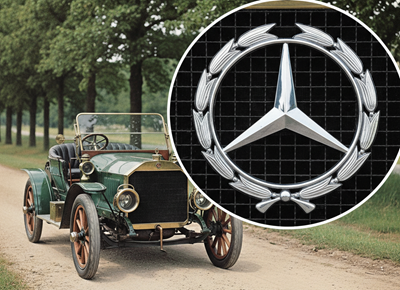
Le succès de ce modèle à Nice fait basculer le nom Mercedes du surnom de course à l’identité commerciale durable. La marque est déposée en 1902, puis l’étoile Daimler vient s’ajouter à cette histoire. Quand Benz & Cie. et Daimler-Motoren-Gesellschaft fusionnent en 1926 pour former Daimler-Benz AG, le nouvel ensemble ne repart donc pas de zéro : il assemble deux héritages industriels, un nom déjà puissant et un emblème déjà reconnu.
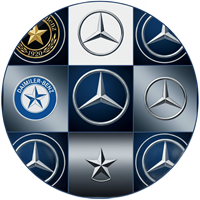
Le badge Mercedes-Benz, qui associe l’étoile Daimler et la couronne de laurier issue de Benz, raconte exactement cela. Il ne célèbre pas un fondateur unique, mais la réunion de plusieurs trajectoires qui avaient fini par converger.
D’une marque de prestige à un constructeur de référence
Entre les années 1920 et les années 1950, Mercedes-Benz construit sa réputation sur un équilibre assez rare : des voitures de représentation très visibles, mais aussi une forte culture de fabrication en série, de véhicules utilitaires et de rigueur mécanique. La marque occupe le sommet du marché, tout en restant attentive à la durée, à l’endurance et aux usages professionnels. C’est l’une des raisons pour lesquelles son histoire ne se limite pas aux grandes limousines et aux coupés de prestige.
Cette logique apparaît clairement avec la 260 D de 1936. Commercialement, ce modèle n’a pas le pouvoir de fascination d’une sportive ou d’une grande berline, mais il ouvre une voie essentielle : celle du Diesel en voiture particulière de série. Mercedes-Benz ne s’y engage pas pour produire un objet spectaculaire. La marque y voit plutôt une solution rationnelle pour les gros rouleurs, les taxis et les usages où la sobriété compte autant que la vitesse.
Ce souci du concret restera une constante. Même lorsque Mercedes met en avant le luxe, l’image ou la puissance, elle garde souvent un fond d’ingénierie appliquée : autonomie, solidité, refroidissement, endurance, comportement stable à haute vitesse. C’est ce mélange entre statut et méthode qui distingue durablement la marque.
La sécurité comme chantier permanent
S’il faut isoler un domaine où Mercedes-Benz a pesé bien au-delà de ses propres modèles, c’est sans doute celui de la sécurité. La marque ne l’a pas inventée seule, bien sûr, mais elle a souvent fait le lien entre recherche, brevet, essais et diffusion en série. Ce travail ne tient pas à un seul dispositif : il repose sur une accumulation de solutions parfois discrètes, parfois décisives.
La carrosserie de sécurité et les crash tests
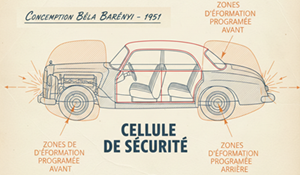
Au début des années 1950, l’ingénieur Béla Barényi formalise le principe d’une carrosserie composée de zones déformables à l’avant et à l’arrière, associées à une cellule centrale rigide pour les occupants. Le brevet date de 1951, et l’idée devient un repère majeur de l’ingénierie automobile moderne. Mercedes-Benz complète cette réflexion par un travail systématique sur les essais de collision : à Sindelfingen, les crash tests deviennent à partir de 1959 un outil normal de développement.
ABS, airbag et ESP
La même logique se retrouve plus tard dans l’électronique d’aide à la conduite. En 1978, l’ABS entre en série sur la Classe S’et rend le freinage d’urgence plus maîtrisable. En 1981, Mercedes-Benz présente l’airbag conducteur associé à un prétensionneur de ceinture, puis élargit progressivement le système. En 1995, l’ESP apparaît sur un coupé de la famille Classe S’avant d’être généralisé sur l’ensemble de la gamme.
Ce qui importe ici n’est pas seulement la date de première apparition. L’enjeu est la capacité à faire passer une innovation du prototype ou du haut de gamme vers des usages plus larges. C’est ainsi que Mercedes-Benz a souvent agi : en industrialisant des avances qui finissent par sembler évidentes après coup.
Moteurs, Diesel et performances : la technique comme langage
Mercedes-Benz n’a jamais séparé complètement l’image de la marque de la question des moteurs. Dès les débuts, la maison se définit par la qualité de ses groupes mécaniques, par le soin apporté au refroidissement, à la fiabilité et à la souplesse d’utilisation. Cette culture se lit aussi bien dans les modèles populaires d’après-guerre que dans les voitures de prestige.
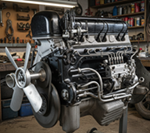
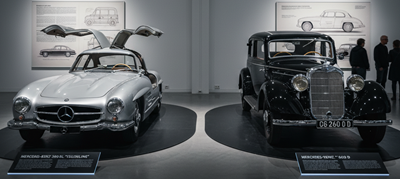
La 300 SL de 1954 en reste l’un des jalons les plus célèbres. Issue de la compétition, elle introduit l’injection directe sur un moteur quatre temps de série et montre que la recherche de performance peut déboucher sur une solution concrète, reproductible et immédiatement identifiable. La voiture fascine par ses portes papillon, mais elle compte aussi parce qu’elle traduit une manière très Mercedes de transformer la course en vitrine technologique.
À l’autre bout du spectre, la lignée Diesel rappelle que la marque ne poursuit pas seulement la vitesse. De la 260 D’aux berlines Diesel d’après-guerre puis aux grands six-cylindres plus récents, Mercedes-Benz travaille aussi la durée, le couple, l’économie d’usage et la capacité à parcourir de gros kilométrages. Cette coexistence entre sport, prestige et endurance explique une partie de la fidélité de la clientèle.
AMG, Formule 1 et nouvelle phase électrique
La compétition occupe depuis longtemps une place centrale dans le récit Mercedes. Les Flèches d’Argent des années 1930, puis les titres de Juan Manuel Fangio en 1954 et 1955, donnent à la marque une aura sportive que les voitures de route ne font qu’amplifier. Après le retrait de 1955, cette dimension ne disparaît jamais tout à fait ; elle change de forme et réapparaît régulièrement au fil des décennies.
AMG et le retour d’une culture de performance
En 1967, Hans Werner Aufrecht et Erhard Melcher fondent AMG comme bureau d’ingénierie dédié aux moteurs de compétition. Quatre ans plus tard, la 300 SEL 6.8, la fameuse « Red Pig », décroche sa victoire de classe et la deuxième place au général aux 24 Heures de Spa. L’épisode est important parce qu’il donne à AMG une visibilité mondiale et montre qu’une lourde berline Mercedes peut devenir une machine de course redoutable.
Depuis, AMG a quitté la marge pour devenir la branche performance de la maison. Pourtant, un trait d’origine demeure : l’idée que la mécanique mérite une forme de responsabilité individuelle. La philosophie « One Man, One Engine », mise en avant pour les moteurs assemblés à la main à Affalterbach, prolonge cette lecture artisanale au sein d’un grand groupe industriel.
Des Flèches d’Argent à l’interface MBUX
Mercedes revient comme écurie d’usine en 2010, puis domine l’ère hybride à partir de 2014. Huit titres constructeurs consécutifs, de 2014 à 2021, et sept titres pilotes sur la même période rappellent que la marque continue d’utiliser la compétition comme terrain d’endurance, d’efficience énergétique et de développement du groupe propulseur.
Dans le même temps, l’identité de Mercedes-Benz se déplace partiellement vers l’interface, le logiciel et l’électrification. Avec la famille EQ et avec MBUX, lancé en 2018 puis largement diffusé, la marque ne se juge plus seulement à sa mécanique ou à son confort de roulage, mais aussi à sa gestion énergétique, à son ergonomie numérique et à ses aides à la conduite. Ce n’est plus tout à fait le monde du Patent-Motorwagen, mais la méthode reste reconnaissable : tester, fiabiliser, industrialiser, puis diffuser.
Cette histoire de la marque Mercedes-Benz se lit aussi à travers l'histoire de la Mercedes-Benz SLK, ainsi que la Mercedes-Benz SLK R170.
Sources
- Mercedes-Benz Group, Beginnings of the automobile: The predecessor companies (1886-1920)
- Mercedes-Benz Group, Mercedes: the brand name that shines out for over 120 years
- Mercedes-Benz Group, The Mercedes star is born
- Mercedes-Benz Group, 140 Years Milestones
- Mercedes-Benz Public Archive, 260 D
- Mercedes-Benz Group, Vehicle Icons from 140 years
- Bosch, 50 years of Bosch ABS history
- Mercedes-Benz Group, Mercedes-Benz Plant Affalterbach
- Mercedes-AMG PETRONAS F1 Team, Brixworth Headquarters
- Mercedes-Benz Group, MBUX Hyperscreen
