







Notre Mercedes SLK 230 Kompressor de 1996 dans le golfe de Saint-Tropez
Donnée par Bruno, le frère de Jean-Noël, cette SLK 230 Kompressor est à la fois notre première Mercedes et une vraie voiture de promenade dans le Sud.
Notre SLK 230 Kompressor n’est pas arrivée chez nous après des mois de recherche. Elle est entrée au garage par la famille, avec une histoire connue, un entretien suivi et cette petite part d’évidence qui change le regard porté sur une voiture.
Dans notre parc, elle occupe une place à part. Plus récente que nos autres anciennes, comme notre Twingo d’ailleurs, plus fermement ancrée dans les années 1990, elle reste pourtant une vraie voiture de caractère : compacte, propulsion, moteur compressé et toit rigide escamotable. Dans le golfe de Saint-Tropez, c’est aussi l’une de celles qui donnent le plus naturellement envie de partir rouler dès que la météo s’y prête.
Une arrivée par la famille, pas par les petites annonces
La voiture nous a été donnée par Bruno, le frère de Jean-Noël. Ce point compte plus que l’anecdote. Il signifie que cette Mercedes n’est pas une découverte tardive ni un achat fait sur dossier. Elle vient avec une histoire claire, des habitudes d’entretien déjà installées et une relation de confiance qui commence avant même le premier trajet.
Les deux frères ont longtemps travaillé dans l’industrie automobile à Poissy, à travers les périodes Simca, Simca-Chrysler, Talbot puis Peugeot. Dans cet environnement, une voiture n’est jamais seulement un objet de consommation. On l’écoute, on la suit, on sait ce qui a été fait et ce qu’il faudra reprendre un jour. Pour une auto de ce type, cette continuité compte presque autant que le kilométrage.
Notre exemplaire en quelques repères
Notre SLK est une R170 de septembre 1996, bleue, avec un intérieur cuir gris et noir et une boîte automatique. Elle affiche environ 170 000 km et reste proche de son état d’origine, à l’exception de l’autoradio. C’est précisément ce qui nous plaît : elle n’a pas été transformée pour paraître plus jeune qu’elle ne l’est.
- Modèle : Mercedes SLK 230 Kompressor R170
- Date : septembre 1996
- Configuration : bleu, cuir gris et noir, boîte automatique
- Kilométrage : environ 170 000 km
- État : présentation très proche de l’origine, sauf l’autoradio
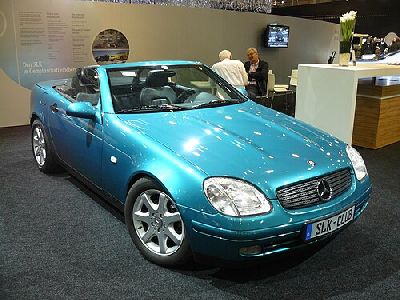
Cette photo montre une SLK R170 de la même première période. Ce n’est pas notre exemplaire exact, mais l’image rend bien la compacité du modèle, son capot long et la façon dont Mercedes a voulu conserver une allure de petit coupé même toit fermé.
Sous le capot et sous le toit, tout le caractère du modèle
Le quatre-cylindres 2,3 litres compressé donne à la voiture une réponse pleine très tôt. Il ne pousse pas de manière brutale. Il accompagne plutôt la conduite avec une réserve constante qui convient bien à l’usage routier. Sur une auto de ce gabarit, cette disponibilité change tout : on profite d’une voiture vive sans avoir à la malmener.
Le vrai cœur du modèle reste pourtant le Vario-Roof. Fermée, la SLK se comporte comme un petit coupé sérieux, facile à laisser dehors ou à prendre pour une sortie un peu plus longue. Ouverte, elle devient une voiture de promenade très simple à apprécier dans le Sud, sans les compromis plus marqués d’une capote souple.
Depuis qu’elle est chez nous, deux interventions ont compté davantage que les autres : le remplacement d’un flexible hydraulique du toit et une reprise de la gestion électronique de la boîte automatique. Rien d’exotique pour une ancienne moderne, mais exactement le type de travaux qu’il faut assumer si l’on veut garder ce genre d’auto fiable et agréable à utiliser.
Ce qu’elle donne sur nos routes du golfe
Sur les départementales et sur autoroute, la SLK paraît dans son élément. Le moteur a du souffle, la direction est précise et la voiture garde cette sensation très Mercedes de densité et de tenue. Elle n’est pas molle, elle n’est pas démonstrative non plus. Elle avance avec assurance.
Sur les routes plus cassées, la suspension peut sembler ferme. En ville, la boîte automatique la rend facile, mais la consommation grimpe vite, ce qui reste son principal défaut dans notre usage. Nous l’acceptons parce que le reste de la voiture répond exactement à ce que nous attendons d’elle.
Toit ouvert, c’est là que cette auto prend vraiment tout son sens dans le golfe de Saint-Tropez. On profite de la lumière, de l’air, du cuir, du bruit du moteur et de cette façon très particulière qu’a la voiture de rester protégée sans perdre le plaisir d’être dehors. Les vitres relevées quand le vent remonte suffisent souvent à garder un bon confort.
Pourquoi elle reste avec nous
Nous ne la gardons pas pour compléter une case dans une collection. Nous la gardons parce qu’elle a une histoire familiale précise, parce qu’elle a été suivie sérieusement avant nous et parce qu’elle apporte quelque chose qu’aucune autre voiture du garage n’apporte exactement de la même manière.
Elle fait le lien entre plusieurs mondes : notre première Mercedes, une auto transmise plutôt qu’achetée, une ancienne déjà moderne, et une vraie voiture de promenade pour les sorties dans le Sud. C’est ce mélange très concret, plus que l’idée abstraite de la voiture collector, qui explique sa place chez nous.
Cette voiture s’inscrit dans une histoire plus large que vous pouvez retrouver dans l’histoire de la Mercedes-Benz SLK. Pour suivre sa remise en état, voir aussi la restauration de notre SLK 230 Kompressor.

Nous ne la gardons pas pour l’immobiliser. Nous la gardons parce qu’elle roule bien, parce qu’elle nous relie à une histoire familiale très nette et parce qu’elle a trouvé naturellement sa place dans nos sorties autour du golfe.
