









History of Citroën: industry, comfort and major technical breakthroughs
Citroën was never quite an ordinary French car maker. From 1919 onward, it linked large-scale production, industrial method, spectacular communication and technical solutions that could immediately be felt on the road. From the Type A to the Traction Avant, from the 2CV to the DS and then the CX, Citroën repeatedly moved the standards of its time.
This history is made of famous cars, but also of a way of thinking about the motorcar: make it lighter, simpler, roomier and more comfortable without losing a clear personality of form. That blend of industry, comfort and technical audacity is what still gives Citroën such a singular place in French motoring heritage.
Technical landmarks: 1919 for the Type A, Citroën’s first mass-produced car; 1934 for the Traction Avant and its front-wheel-drive monocoque architecture; 1948 for the 2CV and Type H in the years of reconstruction; 1955 for the DS, which pushed the Citroën idea of comfort and advanced engineering much further.
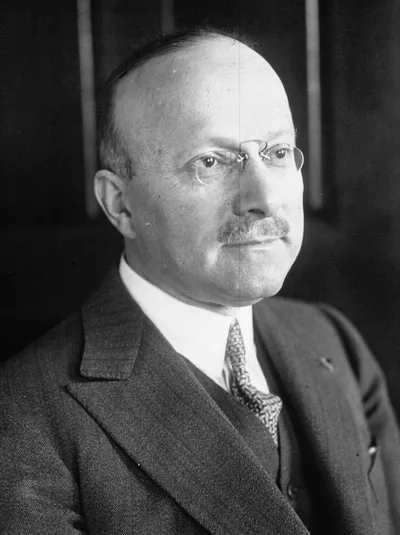
André Citroën, an industrialist before he was a car maker
The history of Citroën begins before the first car. André Citroën first made his name in industry through the double-helical gears he developed at the beginning of the twentieth century. The pattern became the marque’s emblem, but it also says something essential: Citroën was born from engineering, manufacturing and organisation, not from coachbuilding taste alone.
At Mors, where he was called in from 1908 to reorganise production, André Citroën closely observed modern industrial methods and became deeply interested in rationalised flow. The First World War reinforced that experience, as his factory then worked at high volume for ammunition. Once the armistice came, the tool had to be converted. Citroën chose a very clear objective: produce a popular car, ready to use, built in series and sold to a far broader public than the still largely artisanal manufacturers of the time.
The Type A 10 HP, launched in 1919, was the first Citroën and remains, in the brand’s official history, the first mass-produced French car. It was not conceived as an exceptional machine for a small elite. It had to be efficient, economical, easy to buy and easy to maintain. From the beginning, Citroën tried to make the motorcar an object of wide distribution, supported by a network, service, parts and a coherent public identity.
The 1920s: industrial method, steel and communication
During the 1920s, Citroën did not merely build a range. It built a method. The marque multiplied body styles, developed its sales network, introduced credit practices and invested heavily in advertising. Looking back, what stands out is the coherence between manufacturing and the storytelling of modernity. A Citroën had to be seen as an advanced car, but also as a car that was available, recognisable and concretely useful.
This period also brought several innovations that became important in the company’s history. The official Citroën centenary dossier, for example, highlights the B10 of 1925 with its all-steel bodywork, a sign of a manufacturer already pushing production techniques beyond matters of style. A few years later, the Rosalie helped establish the image of a Citroën that was both robust and technically ambitious, notably around the floating engine, presented as progress in smoothness and refinement.
At the same time, Citroën cultivated public presence with a rare sense of demonstration. The half-tracks crossed the Sahara at the end of 1922, then came the Croisière Noire and the Croisière Jaune. In 1925, the Citroën name appeared in lights on the Eiffel Tower. None of this was mere spectacle. The marque wanted to show that a modern car was not a whim but a tool able to cross, connect, serve and impress without abandoning industrial efficiency.
1934: the Traction Avant, the true break
The great technical turning point came in 1934 with the Traction Avant. Citroën was not simply presenting a new model. It was putting on the road a car that broke with several established conventions at once. The Traction was lower, more aerodynamic and surer in road holding, but above all it rested on a landmark architecture: front-wheel drive, monocoque construction, independent front suspension and hydraulic brakes. For a high-volume manufacturer, the package represented a major rupture.
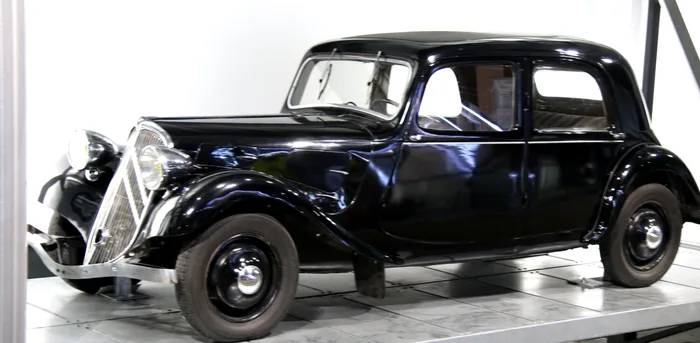
The official centenary dossier describes the Traction Avant as the first mass-produced monocoque car. The phrase matters. It means that instead of quietly extending market habits, Citroën chose to combine architecture, road behaviour and perceived safety in one proposal. This was not only a matter of Bertoni styling or visual modernity. It was another way to design the family and middle-class car.
That technical leap was expensive. The launch badly weakened the company and Michelin took over Citroën at the end of 1934. André Citroën died on 3 July 1935. Yet the Traction Avant became one of the strongest foundations in the brand’s history. Production lasted until 1957 and the whole family went far beyond the stage of a brilliant but isolated experiment. With it, Citroën established a lasting habit: putting on the road solutions that rivals had not yet assembled in one accessible car.
Post-war years: Type H, the 2CV and comfort designed for use
The Second World War interrupted that momentum, but reconstruction made Citroën’s logic even more visible. At the end of the 1940s, the marque proposed two very different yet deeply coherent answers. The Type H, launched in 1947 and sold from the following year, applied to the utility vehicle the advanced layout already seen on the Traction: front-wheel drive, a low floor and a useful load area that was easy to exploit. The centenary dossier presents it as the first mass-produced front-wheel-drive van.
At the same moment, the 2CV appeared at the Paris Motor Show on 7 October 1948. Its project had begun in the 1930s under the codename TPV, for “Toute Petite Voiture”. Once again, Citroën was not starting from prestige but from a problem to solve. It needed a light, economical car able to carry four people and some load, comfortable enough for poor rural roads and simple enough to maintain without fuss. The small Citroën was not minimalist by accident. It had been simplified in the service of a very demanding programme of use.
This is where comfort becomes decisive in Citroën’s history. The marque did not reduce comfort to softer upholstery or richer presentation. Comfort also passed through suspension travel, ease of command, access on board, modularity and the intelligence of space. Citroën Origins explicitly keeps that lineage alive by presenting the long-travel suspension of the 2CV as a major point in the brand’s comfort identity.
1955: the DS, or technical ambition made visible
In 1955, the DS changed the image of Citroën on an international scale. Its Flaminio Bertoni line, its long fluid silhouette, its cabin and the way it filtered the road made it instantly distinctive. But the DS matters less as a rolling sculpture than as a technical synthesis. Official Citroën Origins data points to several structuring elements: power steering, hydraulically assisted front disc brakes, a semi-automatic gearbox and, above all, hydropneumatic suspension, which gave the marque a dynamic and comfort signature that is still easy to recognise.
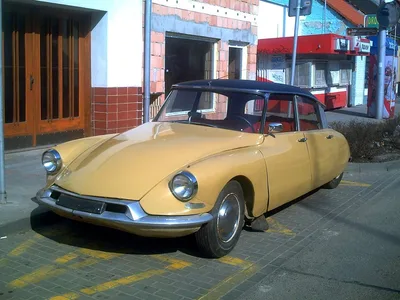
The DS did not replace the Citroën spirit of popular cars. It stretched it upward. The same company could sell an austerely rational 2CV and a large touring saloon that brought new ideas in suspension, braking and control into the public imagination. That is one of Citroën’s great strengths: it did not stay trapped in one segment, but translated a common technical culture into very different uses and price levels.
That culture continued with the Ami 6, Méhari, GS, SM and then the CX, another major Citroën moment in which aerodynamics, ergonomics and ride comfort were assembled into a highly distinctive proposal. Even when industrial constraints became tighter, the marque kept looking for an advantage through architecture, road filtering, readable styling and interior space.
From PSA to Stellantis: what remains of Citroën
The merger with Peugeot in the mid-1970s opened a new phase. Citroën then had to work more within group logic, sharing and profitability. It could no longer always impose technical bets as radical as those of 1934 or 1955. Yet a thread remained. The BX, the XM and later several generations of family cars, MPVs and practical vehicles show that Citroën continued to work on space, comfort, ease of use and a certain formal offset from the norm.
Today, as part of Stellantis, Citroën is no longer the daringly independent maker of André Citroën’s years. But reducing the marque to that loss of autonomy would miss the essential point. What remains is a history in which industry, communication and technology constantly intersected. The Type A established the logic of series production. The Traction Avant shifted automotive architecture. The 2CV redefined the useful car. The DS carried comfort and advanced engineering to a very high level.
If Citroën still matters so much in French motoring culture, it is because its cars tell more than the story of a range or a style. They tell of a way of solving concrete problems through engineering and then giving that engineering an immediately visible presence. It is an industrial history, certainly, but also a history of driving, comfort and intelligent use. That is precisely why it ages better than a simple catalogue of famous models.
This Citroën history also comes into focus through the Citroën 2CV story, along with the Citroën 2CV AZ.

Sources
- Citroën : History of Citroën
- Citroën Origins : André Citroën
- Citroën : Citroën centenary, official history dossier
- Citroën Origins : DS
- Citroën Origins : Traction 7A
- Wikimedia Commons : File:André Citroën 1932.jpg
- Wikimedia Commons : File:1934 Citroen Traction Avant 7A.jpg
- Wikimedia Commons : File:Citroen DS 19.JPG
