








History of the 2CV: from the TPV project to a remarkably complete popular machine
The 2CV is often told as a modest car that became a national symbol. That is true, but incomplete. Its real singularity lies in the rigour of its technical programme: low weight, front-wheel drive, an air-cooled flat-twin, long-travel suspension, easy maintenance and space used with unusual intelligence.
To understand the 2CV, one must therefore go back to the TPV project of the 1930s, follow the prototypes hidden during the war and then look closely at the logic of the production car unveiled in 1948 and built from 1949 onward. More than a familiar silhouette, the 2CV is a coherent technical answer designed to last.
Technical landmarks: TPV project launched in 1936; first roadworthy prototype in 1937 with one headlamp and a weight of around 370 kg; public unveiling on 7 October 1948; production from July 1949 with a 375 cc air-cooled flat-twin producing 9 hp; total career of 5,114,969 units including vans.
1936: why Citroën launched the TPV project
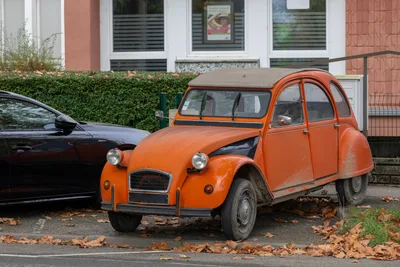
The history of the 2CV officially begins in 1936 with the TPV project, for “Toute Petite Voiture”. The context matters. France was still largely rural, secondary roads were poor, and a large part of the potential clientele had neither the means nor the use for a more expensive automobile. At Citroën, the idea was therefore not to create a chic little car or a hastily simplified one, but to define a tool exactly adapted to a function.
The brief became famous because it sums up the spirit of the programme by itself. The car had to carry four people and 50 kg of luggage or goods at around 60 km/h, while remaining economical, versatile and sufficiently comfortable on degraded ground. The image of a basket of eggs carried across a ploughed field without breaking any captures the real priority very well: suspension, filtering and use came before appearance.
At this stage, the 2CV did not yet exist as a name. What existed was a Citroën method: start from a very concrete need, accept unusual technical choices when the overall result is more accurate, and refuse prestige when it contradicts function. That is already the main difference between the future 2CV and many other merely “economical” small cars.
Very radical prototypes before the war
Official Citroën documentation recalls that the first roadworthy TPV prototype was ready in 1937. It does not yet look like the 2CV known by everyone, but the main lines of the project are already there: very low weight, overall simplicity and the search for maximum efficiency. The 75th anniversary dossier even notes that one prototype weighed around 370 kg and carried only one headlamp, because the regulations of the time did not require two.
By 1939, around 250 pre-production cars were ready for the Paris Motor Show. War prevented the unveiling. Many examples were destroyed and only a few were discreetly preserved at La Ferté-Vidame. This episode is not anecdotal. It shows that the 2CV was not born from circumstance after 1945, but from a reflection already highly advanced before the war. The project survived because it answered a deep need, not because it followed a passing trend.
When Citroën resumed the programme after the war, the design had evolved and the whole had been civilised, but the underlying logic did not change. The car still had to remain light, simple, roomy, easy to live with and surprisingly comfortable for its means. That fidelity to the original brief explains a large part of the strength of the finished result.
1948 and 1949: the production 2CV arrives
The 2CV was unveiled at the Paris Motor Show on 7 October 1948. Reactions were sharp, sometimes mocking, often astonished. Its tall body, canvas roof, narrow wheels and apparent austerity went against part of public expectation. Yet behind that apparent poverty, the car had been very carefully thought through. It was not trying to flatter the eye with ornament, but to solve a mobility problem with the minimum of weight and unnecessary complication.
Production began in July 1949. According to official Citroën communication, the first production 2CV had a 375 cc air-cooled flat-twin producing 9 hp, for a top speed of about 31 mph. Those figures seem modest, but they must be related to weight, running cost and the car’s real purpose. The 2CV was not designed for the modern motorway system that did not yet exist on that scale. It was designed to connect, carry, absorb poor roads and simplify daily life.
Success came very quickly. Orders flooded in to the point that waiting times became enormous. That triumph did not rest on novelty alone. The public quickly understood that Citroën had put on the market a car that made few abstract promises, but fulfilled exactly the promises it did make.
A technical architecture subtler than it looks
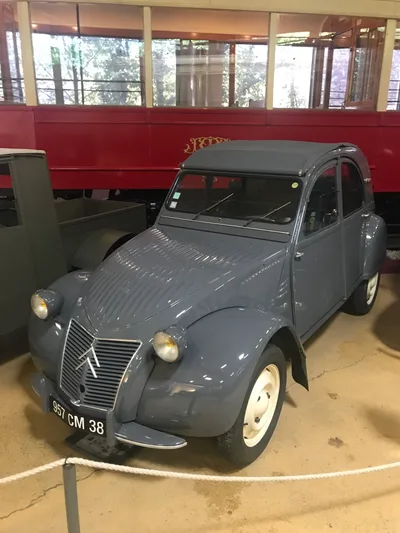
The simplicity of the 2CV is real, but it should not suggest poor design. On the contrary, many elements reveal genuine engineering finesse. Front-wheel drive, to begin with, was not obvious on such a popular car in the late 1940s. It improved the use of space, favoured a more practical floor and contributed to the coherence of the overall layout.
The long-travel suspension is one of the most important points. Citroën Origins still cites it today as a major landmark in the brand’s comfort identity. On the 2CV, it allowed the car to absorb poor surfaces with an ease unknown to many contemporary small cars. That filtering quality explains why the 2CV immediately feels more intelligent than its power level would suggest.
The air-cooled flat-twin belongs to the same logic. Compact, light and free from a complex water circuit, it simplifies maintenance and reduces possible causes of failure. The four-speed gearbox, the folding canvas roof, the removable benches and the easy mechanical access all work in the same direction: each solution either cuts weight, cost and complication or improves real use. The 2CV is not a pile of clever tricks. It is a remarkably coherent whole.
Career development: AU, AZ, special editions and unexpected uses
The 2CV enjoyed such a long life because its base accepted evolution without losing its identity. The official 75th anniversary page recalls the launch of the 2CV AU van as early as 1951. That utility derivative immediately showed the interest of the formula: front-wheel drive, a useful floor, compact size and measured cost. In a country where craftsmen and small professionals needed a simple tool, the van naturally extended the logic of the saloon.
In 1954, the 2CV AZ brought a 12 hp engine and the famous centrifugal clutch. The car did not abandon its sober logic, but it gained ease of use and broader versatility. The range continued to evolve afterwards, not through betrayal but through gradual refinement. Citroën kept the basic structure while improving presentation, mechanics and day-to-day convenience.
Recent official communication also recalls several derivatives that fed the legend: the twin-engined 2CV 4 x 4 Sahara, able to tackle gradients of more than 40 per cent on sand, the Spot, Charleston and Cocorico special series, and the long raids organised by Citroën between 1970 and 1973. All these variations show that the 2CV was never trapped in one rural image. It could be a working tool, a student car, a late style object, a travel machine and even an adventure vehicle.
Why the 2CV became a social phenomenon
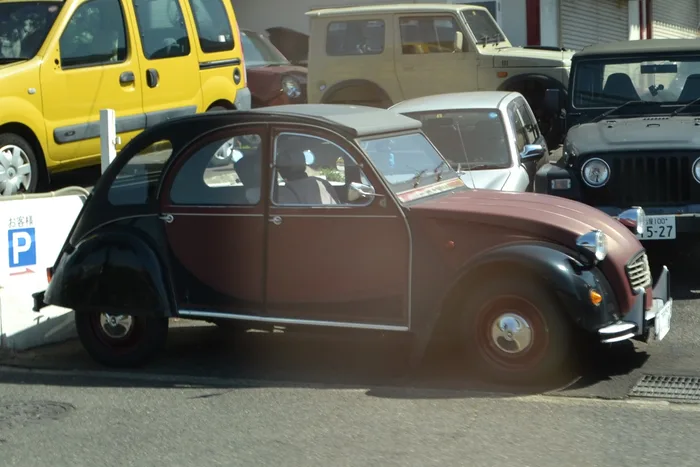
The 2CV remained in production for 42 years, and Citroën built 5,114,969 units in total including vans, of which 1,246,335 were utility versions. Such numbers clearly say something about commercial success, but they are not enough to explain the lasting attachment the car still inspires. The 2CV mattered so much because it corresponded exactly to very different uses without losing clarity.
It could go to market, carry tools, leave for holidays, cross a poorly maintained lane, be repaired far from a major garage and remain economically bearable in a France that was gradually equipping itself. Few cars have been so accurate in the relationship between means invested and service delivered. That accuracy explains why it could appeal to very different publics: farmers, priests, modest families, students, travellers and, later, collectors.
Its other strength lies in technical honesty. A 2CV does not pretend. Its body, mechanics, cabin and performance announce exactly what it is. In time, that honesty becomes a cultural quality. The 2CV reminds us that a popular car can be inventive, architecturally refined and durable without ever chasing prestige for its own sake.
What the 2CV still says today
Today, the 2CV is no longer just a friendly old car. It has become a case study. It shows how a properly defined programme can produce an extraordinarily durable automobile, able to evolve for decades without losing its first identity. In Citroën history, it therefore occupies a very special position: that of a seemingly modest model that stands at the centre of useful comfort, intelligent simplicity and popular mobility.
One may admire its silhouette, collect its special series or debate its versions and colours. But what truly secures the 2CV in long memory is the rigour of its technical design. Beneath a body that has become familiar, it still carries a very current lesson: a car can be light, simple, economical, roomy and comfortable provided it is conceived as a whole. That coherence, even more than nostalgia, is what makes the 2CV a major chapter in French motoring history.
To place the 2CV in context, you can also read the Citroën 2CV AZ, along with the Citroën 2CV AZA.



Sources
- Citroën / Stellantis Media : Historic, Iconic, Legendary: Citroën Celebrates 75 Years of the 2CV
- Citroën / Stellantis Media : Rétromobile 2018 and the 2CV’s 70th anniversary
- Citroën : Citroën centenary, official history dossier
- Citroën Origins : Le Confort Citroën
- Citroën Origins : 2CV Mini-van
- Wikimedia Commons : File:Citroën 2CV (54123672868).jpg
- Wikimedia Commons : File:Citroën 2CV A-AZ 1954 Musée Henri Malartre-3447.jpg
- Wikimedia Commons : File:Citroën E-AZA6 2CV 6 Charleston (23032910152).jpg
