







Renault: from Louis Renault's first experiments to today's cars for everyday life
Renault was born at the end of 1898, when Louis Renault proved that a light little car could climb Rue Lepic in Montmartre and turn that demonstration into the brand's first orders. Very quickly, the early workshop became an industrial company driven by the three Renault brothers, then a marque deeply woven into everyday French life. From the post-war 4CV to the Twingo, from the Renault 16 to recent electric models, Renault's history is less about one fixed style than about a repeated ability to design cars that are easy to understand, practical to use and clever enough to last.
Writing about Renault means more than listing famous models. It means following a manufacturer that often defined itself through use: starting easily, carrying a family, working in town or in the countryside, staying affordable, then updating that promise when the automotive landscape changed. Chronology matters, but at Renault it rarely stands apart from a very concrete idea of what a car is for.
The beginning: Louis Renault, Marcel, Fernand and the Type A
The story starts in Boulogne-Billancourt at the very end of 1898. Louis Renault had not yet built a major company; he was first a stubborn young mechanic trying to find a more convincing solution than the small vehicles already seen around Paris. His well-known early feat was to drive his little car up Rue Lepic, one of Montmartre's steepest streets. That climb was more than a stunt. It showed the usefulness of his direct-drive gearbox, which worked more efficiently than many systems used on small automobiles at the time.
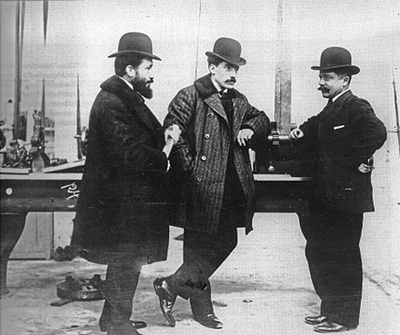
Two months later, Louis's brothers Marcel and Fernand helped create Renault Frères. The formula already says a lot about the balance inside the venture: Louis designed, Marcel supported the sporting and commercial momentum, and Fernand backed the business. The first years still belonged to a flexible small company, but one that quickly understood that automobiles would be sold not only by mechanical quality, but by proof on the road. Races, demonstrations and first customers became stronger arguments than theory.
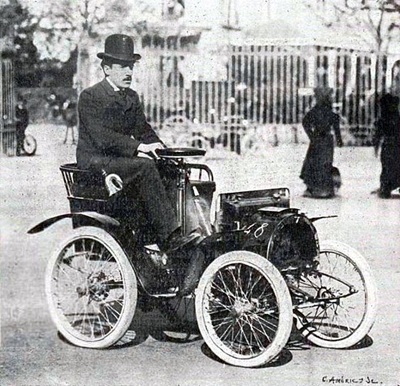
The Type A looks extremely simple from today's point of view. Yet it fixed several traits that would matter for a long time at Renault: a search for clear mechanical solutions, a willingness to prove value in real use, and a certain lightness of design. It was not yet a popular brand in the later twentieth-century sense, but it was already a brand trying to persuade through concrete results rather than prestige alone.
From workshop to major French manufacturer
In the early twentieth century, Renault changed scale. The company produced more vehicles, became visible in competition and gradually widened its range. Renault taxis, which left a durable mark on the brand's image, show that ability to move beyond leisure motoring and into ordinary traffic: the kind that works, carries people and wears out every day. That practical presence mattered as much as any sporting reputation. It anchored Renault in the modern city.
Over time, the business became far more important industrially. Billancourt turned into a central place in French car production, and Renault's story became closely tied to that of national industry, with its accelerations, tensions, wars and reconstructions. The factory on Île Seguin, developed from 1919 onward, symbolised this change in scale. Renault was no longer living in the age of the artisan workshop. It had become a major manufacturer able to speak to several publics at once.
That rise was never perfectly smooth. Renault's history crosses the shocks of the century, human losses, reorganisations and, after the Second World War, the nationalisation of the company. The framework changed, but the main thread remained: Renault kept being judged on its ability to offer cars suited to a society that was rebuilding itself and changing fast.
The 4CV and post-war France
The 4CV occupies a special place because it crystallised Renault's entry into post-war mass motoring. Its development began clandestinely during the Occupation, and its launch in October 1946 came in a France that had to rebuild its means of transport. That timing explains a great deal: the 4CV mattered not only because it was compact or friendly-looking, but because it answered a precise need for an economical, habitable car that the widest possible public could understand and afford.
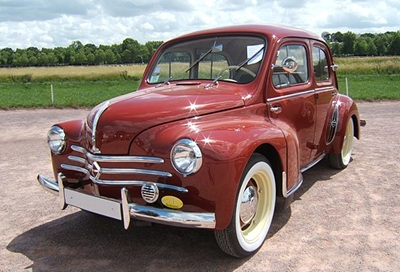
The car's famous slogan, built around four doors, four seats, four fiscal horsepower and a clearly stated price, captured that ambition for readable simplicity. Renault understood something essential: a popular car does not succeed simply by being cheaper. It must also fit naturally into people's lives. The 4CV entered streets, households and the collective imagination because it seemed properly placed there rather than imposed from above.
That success shaped everything that followed. It gave Renault a strong industrial and symbolic base. The brand was no longer only old or important; it became one of the most obvious names in everyday French motoring. On that basis Renault could later develop bigger, smaller, cleverer or more specialised cars while still starting from real use.
Renault 4, Renault 8, Renault 16, Renault 5: use before effect
The 1960s and 1970s are probably the decades when Renault most clearly imposed its own way of thinking about the car. The Renault 4, launched in 1961, became the flexible car par excellence: family-friendly without stiffness, rural without folklore, utilitarian without heaviness. It could handle poor roads, loads, modest lives or active ones, and its very long career says enough about the accuracy of the brief.
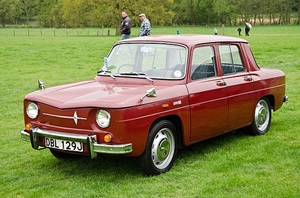
In that same landscape, the Renault 8 established another presence: that of a compact saloon seen everywhere on French roads, with sporting versions that also strengthened the brand's reputation. It reminds us that Renault did not speak only to cautious families; it could also give character to widely distributed cars. That mix of useful seriousness and mechanical liveliness matters in the brand's identity.
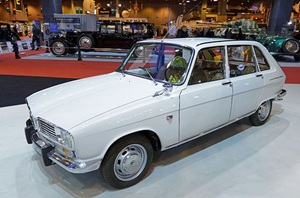
The Renault 16, introduced in 1965, marked another turning point. With its hatchback body and a layout designed around versatility, it showed that a family car could move beyond the classic three-box saloon without losing elegance or comfort. Today that idea feels obvious; at the time it was not. The 16 says something deep about Renault: innovation did not always come through spectacle, but often through improvements that became visible when loading, travelling or living with the car.
The Renault 5, launched in 1972, condensed that philosophy into a shorter, more urban format. It answered a different era, different traffic rhythms and a different relation to style, while remaining easy to understand. Its success came from its size and shape, but also from its immediate sense of being right for the modern city. Renault knew how to update its range without breaking its main language: practical, readable cars well placed in their time.
The Twingo and the return of cars designed to be lived with
When the Twingo arrived in 1993, Renault recovered a move that could have seemed lost: surprising people with a small car that looked unlike anything else while remaining perfectly thought out for daily use. Its one-box silhouette, wheels pushed to the corners, sliding rear bench, unusual interior and simple launch strategy with few versions and few colours created an immediate effect. The car was cheerful, but it was not only about a friendly face. It was first an intelligent answer to lack of space, cost of use and the need to move differently.
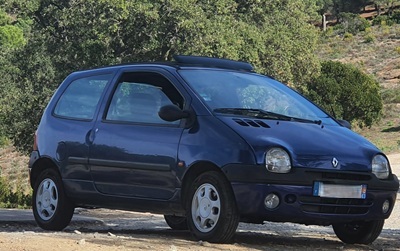
The Twingo revived an expression often associated with Renault: the car for living with, the "voiture à vivre". The phrase matters only if it describes something tangible, and here it did: interior room, modularity, a simplified offer and a less solemn relation to the automobile. In the same years and those that followed, Clio, Scénic, Kangoo and Espace each extended that attention to real uses, whether for the city, leisure, family life or work.
This period did not erase industrial tensions or the sector's difficulties, but it showed that Renault could still recover a clear idea of the car when the market grew confused. The brand does not win only when it produces a technically striking model. It wins above all when it formulates an everyday use clearly enough for the public to recognise itself in it at once.
Renault today: reread heritage, electrified range
Today Renault rereads its own history without becoming trapped in it. The brand presents both hybrid and fully electric ranges while bringing back names loaded with memory, such as Renault 4, Renault 5 and Twingo. The return of those old names is not just nostalgic theatre. It is a way of showing continuity: Renault has often tried to make technology more accessible, the car easier to live with and innovation more concrete than theoretical.
The context, of course, has changed. Electrification, industrial decarbonisation, software platforms and quickly evolving urban habits are shifting priorities. Yet the guiding idea is still recognisable when it works: Renault still looks for cars that are understandable, useful, not unnecessarily solemn, and able to connect a popular heritage with very contemporary constraints. The best way to read Renault's history is therefore not to search for one permanent styling line. It is to follow a method: observe ordinary life, then try to insert an automotive solution precise enough to last.
From the Type A to the Twingo, from the 4CV to the electric Renault 5, the brand has known breaks, mistakes and several restarts. One thing remains: at Renault, the models that matter most are often those that seem drawn at street level, family level, luggage level and repeated-journey level. That, more surely than pure prestige, is where the durable core of its history lies.
This Renault history also comes into focus through the Renault Twingo story, along with our Twingo Hélios in the Gulf of Saint-Tropez.

Sources
- Renault Group, Our history
- Renault Group, Île Seguin, Renault’s historic home
- The Originals Museum, Type A
- The Originals Museum, 4CV
- The Originals Museum, R16 TX
- The Originals Museum, R5 TL
- The Originals Museum, Twingo
- Renault Group, Renault, innovation that serves everyone
Chronicle through time
Louis Renault, Rue Lepic and the Type A: proving the marque on the road
The rue Lepic episode is more than folklore. It already sums up the Renault method in 1898: prove a mechanical solution on the road before turning it into a commercial argument.
