



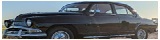
Panhard: from early automotive pioneers to the brand's last civilian cars
Panhard is not only a very old French marque. It is one of the names that helped define the shape of the modern automobile before following a more singular path through high-end cars, very technical light saloons and, later, light armoured vehicles. Reading Panhard today means following a company that was often right, but rarely aligned with the dominant market.
The beginning: from mechanical engineering to early automobiles
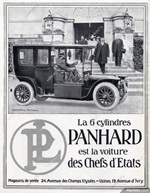
Before it became a car maker, Panhard was first a mechanical engineering company. The business grew around woodworking machinery and then around engines built under licence, first gas engines and later petroleum engines. That transition from workshop equipment to propulsion is the decisive point: René Panhard and Émile Levassor did not start from nowhere, they turned an already solid industrial base into a serious automotive venture.
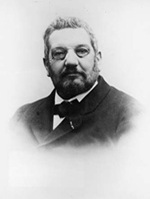
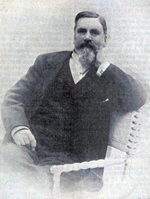
By the end of the 1880s, the firm was mounting Daimler engines built for the French market onto self-propelled vehicles. The tests took time and the solutions were still changing, but the essential move had been made: the static engine was becoming a real automobile. Brand historians and clubs often present October 1891 as the moment when Panhard & Levassor began selling the first standard-series automobiles. Without turning this into a contest of absolute priority, one point is enough: Panhard stood in the front rank of the firms that moved the automobile from experiment to regular production.
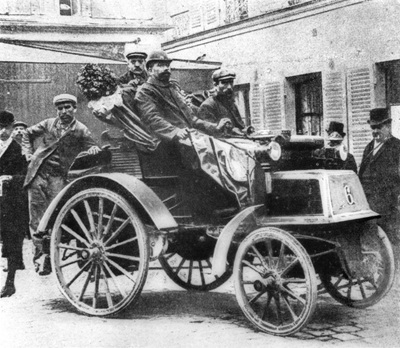
This seniority matters because it produced a method. Very early on, the company tried to arrange the mechanical organs in a clear, accessible and repeatable order. That taste for neat solutions rather than sheer spectacle remained one of the strongest threads in Panhard history.
The Panhard system and the years of proof on the road
What later became known as the Panhard system sums up the brand's influence on the modern automobile: front engine, clutch, separate gearbox and drive to the rear wheels. That layout did not become fixed overnight, but at Panhard it became a kind of mechanical grammar that would remain influential for a very long time. It was not a late slogan; it was a way of bringing order to an uncertain technology.
The road events and endurance trials of the late nineteenth century then served as a laboratory. Paris-Rouen, Paris-Bordeaux-Paris and other long-distance events showed not only speed, but stamina, repairability and overall coherence. Émile Levassor left a strong mark there until his death in 1897. According to the Doyennes history, Panhard was still the world's largest manufacturer and exporter in 1900. Even if Renault, Peugeot and Citroën dominate the later national story, Panhard therefore occupied a far more central place at the beginning than many readers now imagine.
After Levassor, Arthur Krebs helped stabilise the company and carry it into a new phase. New engines appeared, ignition and carburation improved, transmission evolved and the firm built a reputation for seriousness that extended beyond France. Panhard was not only selling cars; it was selling the idea that a motor car could become a coherent technical product instead of an approximate machine reserved for wealthy experimenters.
Between the wars: high-end cars, valveless engines and the Dynamic
After the First World War, Panhard did not take the turn toward large-scale popular production. While Renault, Citroën and Peugeot moved toward broader, more standardised output, Panhard stayed loyal to limited-volume, often high-end cars supported by elegant bodies, refined mechanical choices and a workshop culture more traditional than that of the great modern industrial groups. That decision gave the marque a very clear identity, but it also deprived it of part of the market that became decisive in the 1920s and 1930s.
The valveless engines adopted from the 1910s onward and retained until the eve of the Second World War summarise that singularity well. They brought smoothness, silence and technical distinction, but at the price of more expensive production. Panhard thus found itself locked into a demanding definition of the automobile, admirable in engineering terms, yet less and less compatible with an industry shifting toward rationalisation and larger volumes.
The 1936 Dynamic was probably the peak of that ambition. Its aerodynamic body, unitary construction, torsion-bar suspension, hydraulic brakes and famous central steering wheel show a marque that still knew how to innovate boldly. Yet the timing was poor. The crisis, the caution of a bourgeois clientele already unsettled and the tense social climate made this audacity hard to turn into profit. The Dynamic therefore remains less as a mass-market success than as a brilliant proof of the level of invention Panhard could still reach.
After 1945: Dyna X, Dynavia, Dyna Z and another idea of the French car
After the war, Panhard changed register completely. The moment no longer called for great prestige cars, but for sober, light automobiles able to run on little fuel and little material. The Dyna X, presented in 1946, embodied that conversion. Its air-cooled flat twin, very low weight and extensive use of aluminium gave it a character unlike anything else on the French market. It was not charming in a conventional sense, but it answered the needs of its time exactly: economy, liveliness and genuine family usefulness in a modest format.
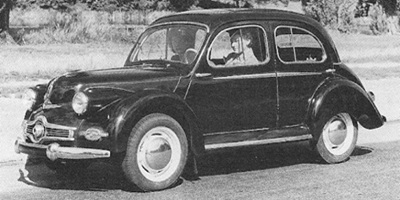
The Dyna X mainly showed that Panhard had not lost its essential reflex: seeking efficiency through intelligent design. The company lacked the resources of the biggest makers, so it compensated with close thinking about weight, aerodynamics, mechanical access and overall efficiency. That same line led to the Dynavia prototype, shown in 1946, and then to the Dyna Z, which took up that spirit in the mid-1950s.
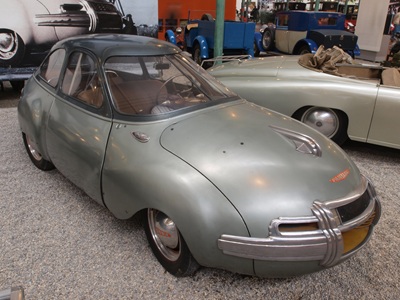
With the Dyna Z, Panhard pushed further the idea of a very aerodynamic, roomy and light saloon. Louis Bionier's design gave it a shape that was immediately recognisable, soft without weakness and technical without coldness. The first largely aluminium bodies proved expensive to build, which later forced the marque back toward steel for cost reasons. That detail says much about Panhard's difficulties: solutions that were often right and sometimes brilliant, yet too expensive to industrialise at large scale inside an already fragile company.
PL 17 and 24: the final civilian years
The PL 17, which took over in 1959, did not break with the Dyna Z so much as refine it. The line became tighter, the range more stable, the flat twin evolved again and the whole car remained faithful to the brand's singular qualities: contained weight, reasonable fuel use, real room and the feeling of a car designed by engineers who still thought about every kilogram. Even its name is remembered by enthusiasts as a compact summary of what the car was supposed to achieve.
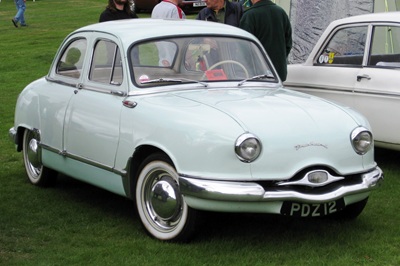
But the tide was running against Panhard. Tastes changed, the competition became heavier, more powerful and better distributed. Excellent endurance results and success on efficiency indexes at Le Mans were no longer enough to compensate for weak industrial means. Under the growing control of Citroën, the marque could not renew its range freely. The 24, presented in 1963 and produced from 1964, therefore appeared as a magnificent last effort: low, clean-lined, genuinely thought through for safety, carefully equipped and elegant in a restrained way that seemed more modern than the resources of its maker.
The 24 had no true successor. Citroën opposed the idea of a new saloon that might compete with its own range, and Panhard no longer had the resources to develop an entirely new engine. Civilian production ended in 1967. It was not only the end of a car brand; it was the disappearance of a specifically French way of thinking about the automobile through lightness, efficiency and calm originality.
A second life in light armoured vehicles
The Panhard name did not disappear. The company already had military experience, but that orientation became central once civilian car production receded. The EBR, delivered to the French Army from 1951 onward, then the AML in the 1960s, show how naturally part of Panhard's know-how could move into light armoured vehicles: compactness, mobility, clever mechanical solutions and a search for effectiveness in real terrain. The VBL, selected in the mid-1980s and in service from 1990, extended that line in a different industrial age.
This move from the road to the military sphere should not obscure the core of the story. If Panhard still matters, it is first because the marque helped define the modern automobile before producing some of the most singular French cars of the twentieth century. From the early mechanical layouts to the Dyna models and the 24, the company often chose the most subtle technical answer rather than the easiest one to sell. That probably explains both its greatness and its fragility.
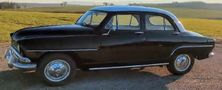
This Panhard history also comes into focus through the collectible Panhard Dyna Z, along with the Dyna from Panhard.
Sources
- Les Doyennes de Panhard & Levassor, History of the firm
- Panhard Concept Historique, De 1890 à 1940
- Panhard Concept Historique, De 1945 à 1967
- Dynamic Club Panhard et Levassor, Les Panhard
- Panhard Concept Historique, Page militaire
- Arquus, Elaboration du cahier des charges de l’Engin Blindé de Reconnaissance (EBR)
- Arquus, Panhard AML 60
- Arquus, Le ministre de la défense choisit le Véhicule Blindé Léger (VBL)
