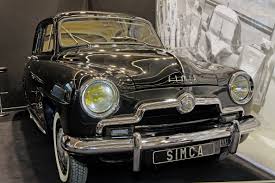
The Simca 9 Aronde, the first chapter of a long career
The Simca 9 appeared in April 1951 and opened the Aronde story. Its importance lies less in rarity than in what it announced: a modern monocoque saloon, well drawn and designed to help Simca grow.
Seen today, it mainly marks the moment when the brand finally found a silhouette and a method of its own.
Key facts. April 1951, 1,221 cc engine with 45 hp, monocoque body and stepped grille: the Simca 9 defined the starting codes of the whole Aronde line.
A genuinely new saloon for Simca
The Simca 9 was shaped at the end of the 1940s, when the brand needed to renew its image. It did not merely replace the Simca 8. It opened a new way of designing and selling a popular car. The project was meant to give Simca a basis that was more modern, more ambitious and easier to identify.
When the car was unveiled in April 1951, it immediately set the tone. It was not a single oddity, but the beginning of a line meant to last.
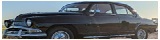
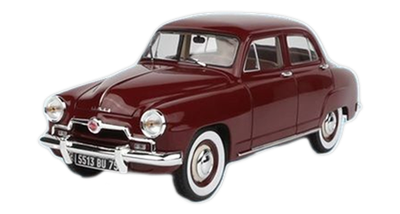
The Simca 9 sets the original Aronde silhouette.
A modern shape, easy to recognise
The first striking point was the monocoque body, a first for Simca. The shape was cleaner than that of the Simca 8, the boot was better integrated and the stepped grille gave the front end an identity of its own. The car remained compact, yet it looked more serious and more up to date than many direct rivals.
The 1,221 cc four-cylinder engine came from a familiar basis, but the overall package was more coherent. The Simca 9 did not rewrite French engineering on its own; it mostly brought together the right choices at the right moment.
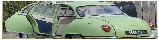
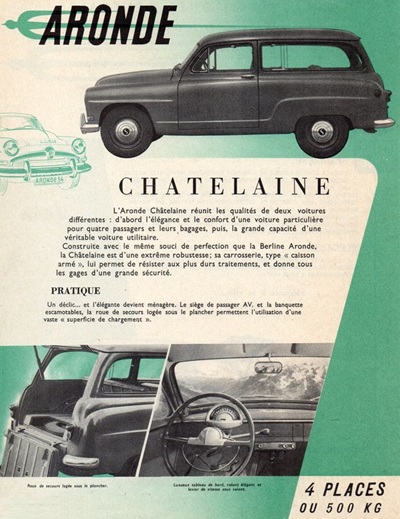
The Chatelaine shows how quickly the range opened up to estate versions.
A basis that quickly widened into a range
Simca understood early that the Aronde should not stay a single saloon. From 1952 and 1953 onward, the catalogue added cheaper trims, coupe and cabriolet variants, and a whole family of estates and utility models. The Quotidienne answered the need for a more affordable car, while the Chatelaine, Commerciale and Messagere were aimed at more practical uses.
That fast expansion matters. It shows that the Simca 9 was already serving as the industrial, commercial and promotional base of the whole line.
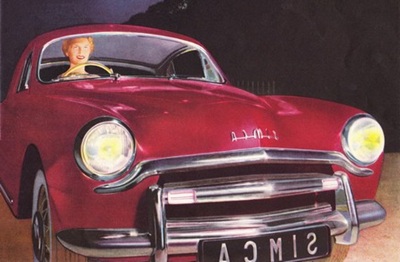
The Simca 9 Sport shows that the first range also cared about style.
Between popular car and style statement
The Simca 9 found a rare balance. It stayed accessible, yet it also allowed more elegant interpretations such as the Coupe de Ville, the Week-End cabriolet and the Grand Large coach. Simca was giving a mass-market basis more ambitious readings without cutting the link with ordinary buyers.
That is also what made the car stand out in early-1950s France: it was not relying on reason alone, it was already taking care of appearance.
Why the Simca 9 still matters
The Simca 9 was not yet the Aronde 1300 or the P60, but it established everything that followed: the general architecture, the tone of the range, the logic of multiple versions and Simca's position in the French market. It marks the real beginning of the Aronde story.
For enthusiasts today, it remains far more than a first series. It tells the moment when Simca fully became Simca.
The Simca 9 opens the Aronde career, yet many examples have been altered, repainted or mixed over time. To identify the first chapter of the range correctly, it is better to rely on a few clear clues of shape and presentation.
The Simca 9 is best read through coherent details rather than a vague memory of model years.
The stepped grille as the immediate sign
The famous stepped grille remains the best-known clue. It gives the nose a very clear identity, more upright and more marked than on later Arondes.
This sign does not always suffice on its own, especially if the car has been altered. It must be placed back into the whole shell and its fittings.
A monocoque body that changes the understanding of the model
The monocoque body matters greatly in the model’s story. It contributes to the Simca 9’s modernity and helps distinguish it from the earlier Simca generation.
For today’s enthusiast, this is not only a technical detail. It is also a clue to positioning and industrial ambition.
Always look for full coherence
A true Simca 9 is read through the coherence between front end, trim, body and production period. One correct part mounted on a mixed car still does not tell the right story.
Serious identification therefore means observing the whole car calmly. That remains the best way to distinguish a faithful example from an approximate reconstruction.
Les Caramagnols brings together our auto-retro pages, our classic cars and our walks through the Gulf of Saint-Tropez. The site links our collector models, our road stories and the places around them.