







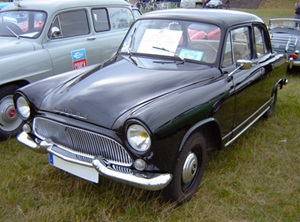
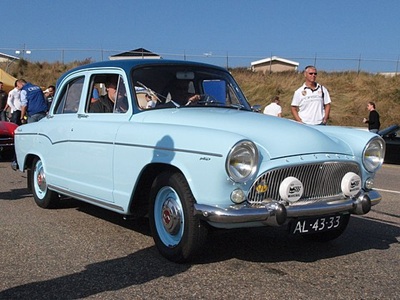
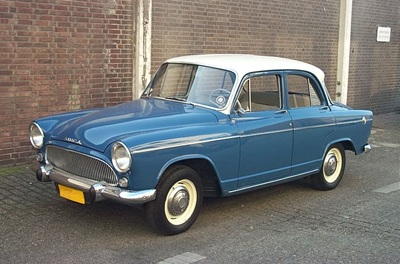
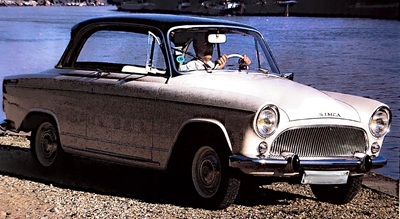
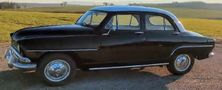
Une Aronde P60 ne se reconnaît pas à un badge isolé. Les emblèmes se remplacent, les baguettes voyagent d’une voiture à l’autre et beaucoup d’exemplaires ont reçu des pièces de plusieurs millésimes. La méthode la plus sûre consiste à partir des éléments difficiles à modifier — carrosserie, vitrage, pavillon, tableau de bord — puis à confronter ces ordres de grandeur à la finition et au moteur annoncés.
Présentée à l’automne 1958 pour le millésime 1959, la P60 reste membre de la famille Aronde, mais Simca transforme largement son apparence. Les berlines gagnent une carrosserie aux surfaces vitrées plus généreuses, un toit prolongé et un avant entièrement redessiné. Le résultat est plus spectaculaire que la Ligne Océane de 1956-1958, tout en conservant l’architecture familière de la populaire de Nanterre puis de Poissy.
Commencer par la face avant
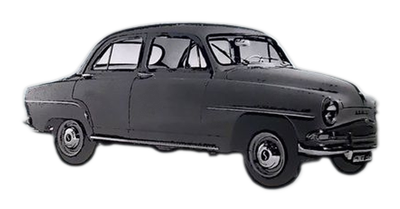
Le nez fournit le contraste le plus immédiat. Une Aronde 1300 Ligne Océane possède déjà une calandre large et des casquettes de phares, mais son dessin demeure arrondi. Sur la P60, les casquettes deviennent plus saillantes et les ailes encadrent une ouverture centrale beaucoup plus marquée, souvent décrite comme une « gueule de requin ». Les pare-chocs et les ornements renforcent cette impression de largeur.
Cette signature concerne surtout les berlines et les coachs. Les utilitaires reprennent l’avant P60 tout en conservant une partie arrière plus ancienne : une Châtelaine ou une Intendante ne doit donc pas être écartée parce que son pavillon et sa poupe ne ressemblent pas à ceux d’une Élysée. Les coupés Plein Ciel et cabriolets Océane, carrossés sur une base spécifique, demandent la même prudence. Une calandre seule ne suffit jamais à attribuer une carrosserie ou une finition.
Observer le toit, la lunette et les ailes arrière
Sur une berline P60, le pavillon paraît plus plat. Une nervure court dans son axe et une casquette déborde au-dessus de la lunette arrière panoramique. Les montants et la surface vitrée donnent davantage de clarté à l’habitacle. À l’arrière, les ailes se terminent par des reliefs plus accusés que sur la Ligne Océane. Ces formes sont structurelles : elles résistent mieux aux échanges de pièces que les enjoliveurs ou les monogrammes.
Le profil révèle aussi les changements de millésime. Les premières P60 emploient des baguettes qui forment un décrochement, avec une largeur et une présentation variables selon le niveau de gamme. Lorsque le moteur Rush arrive pour le millésime 1961, les baguettes de caisse deviennent fines et rectilignes sur les modèles concernés. Une auto dotée d’un moteur Rush, de baguettes anciennes et d’un tableau de bord de première série mérite donc une enquête documentaire ; elle peut avoir été réparée, modernisée ou simplement mal décrite.
Le tableau de bord départage les cas ambigus
Simca ne s’est pas contenté de modifier la tôle extérieure. La P60 reçoit un tableau de bord nouveau, prévu pour un autoradio, avec un compteur horizontal. Sur les premières voitures, la vitesse s’affiche sur un ruban à défilement. Les Aronde Rush adoptent ensuite une aiguille se déplaçant dans un cadran horizontal. Cette différence discrète aide à situer une voiture dont les garnitures extérieures ont été changées.
L’instrumentation doit être examinée avec les commandes, la sellerie, les panneaux de porte et les traces de fixation. Un tableau repeint ou une sellerie refaite n’est pas un défaut en soi ; en revanche, le vendeur doit pouvoir expliquer les écarts entre l’année de la carte grise, le moteur, les accessoires et la présentation. Des trous rebouchés sous une baguette, une teinte ancienne visible derrière une garniture ou des supports de monogramme déplacés racontent souvent l’histoire des transformations.
Ne pas confondre modèle, millésime et date d’immatriculation
La dénomination P60 apparaît pour le millésime 1959, donc sur des voitures sorties dès la fin de 1958. Une carte grise de 1958 n’exclut pas automatiquement une P60. À l’inverse, une première immatriculation tardive ne prouve pas qu’une voiture possède les caractéristiques du millésime correspondant : stock, exportation ou formalités administratives peuvent décaler les dates.
Le passage au Rush crée une seconde difficulté. À partir d’octobre 1960, le nouveau moteur à vilebrequin cinq paliers et épurateur d’huile centrifuge remplace progressivement le Flash. Les documents et les clubs parlent alors d’Aronde Rush, tandis que le public continue souvent à employer P60 pour toute la carrosserie. Pour une annonce, « P60 » décrit donc volontiers la silhouette ; pour une restauration, il convient de préciser la version commerciale, le millésime et le type de moteur.
Une vérification en six points avant achat
- Photographier les quatre faces. Une vue frontale montre la calandre et les pare-chocs ; un profil complet révèle le pavillon, les portes, les baguettes et les ailes arrière.
- Identifier la carrosserie. Berline, coach, cabriolet, break ou utilitaire n’ont pas reçu exactement les mêmes transformations.
- Comparer le tableau de bord. Type de compteur, emplacement de radio, commandes et finitions doivent correspondre à la période revendiquée.
- Relever les numéros sans les publier. Le numéro de série, la plaque constructeur et les références du moteur permettent au club de marque de confronter la voiture aux données connues.
- Demander les anciennes pièces et factures. Une modification documentée vaut mieux qu’une apparence conforme obtenue sans historique.
- Consulter un catalogue du bon millésime. Les catalogues commerciaux montrent les ornements, mais une notice technique ou un catalogue de pièces est préférable pour confirmer une référence.
Ce que les photos d’annonce ne prouvent pas
Une photo prise de trois quarts flatte les chromes et masque facilement une poupe d’une autre série. Un monogramme Monaco ne transforme pas une Élysée, pas plus qu’un couvre-culasse rouge ne garantit à lui seul un Rush complet. Les carrosseries anciennes ont connu des chocs, des pénuries de pièces et des restaurations réalisées à une époque où l’authenticité de concours n’était pas la priorité.
Il ne s’agit pas de condamner ces voitures. Une P60 modifiée peut être saine, agréable et historiquement intéressante. La distinction essentielle se situe entre une transformation annoncée et une version prestigieuse revendiquée sans preuves. Le prix et le programme de restauration ne seront pas les mêmes.
Trois familles d’aspects, une identification solide
La carrosserie situe d’abord la voiture dans la génération P60 ; le tableau de bord et les baguettes resserrent le millésime ; enfin, le moteur et la finition permettent de vérifier l’appellation commerciale. Si ces trois familles d’angles d’observation concrets convergent, l’identification devient robuste. Si elles se contredisent, les numéros, les factures et l’avis d’un club Simca doivent primer sur le récit de l’annonce.
La page consacrée à la Simca P60 replace ce modèle dans l’histoire de l’Aronde. Pour distinguer les niveaux de gamme, poursuivez avec Étoile, Élysée, Montlhéry et Monaco : les différences utiles.
