La Garde-Freinet changes the perception of the gulf completely. Here there is no seafront and no broad bay to orient the walk. The village stands inside the Massif des Maures, among slopes, forests, hamlets and ridge roads. It is an inland commune, yet it keeps constant ties with the plains, neighbouring villages and the distant Mediterranean.
This shift in viewpoint is exactly what makes it valuable. La Garde-Freinet helps you understand what the gulf becomes once you leave the quays: a territory of relief, stone, scarce water, woodland, pastoral memory, craft traditions and medieval remains.
Fort Freinet, a hill site and old legends
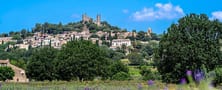
The site of Fort Freinet dominates the heritage reading of the area. Tradition long saw it as a Saracen stronghold, but archaeological work showed instead a medieval fortified village occupied in the late twelfth century and gradually abandoned by the late thirteenth. The rock-cut ditch, the defensive position and the extent of the view are enough to explain the power of the place.
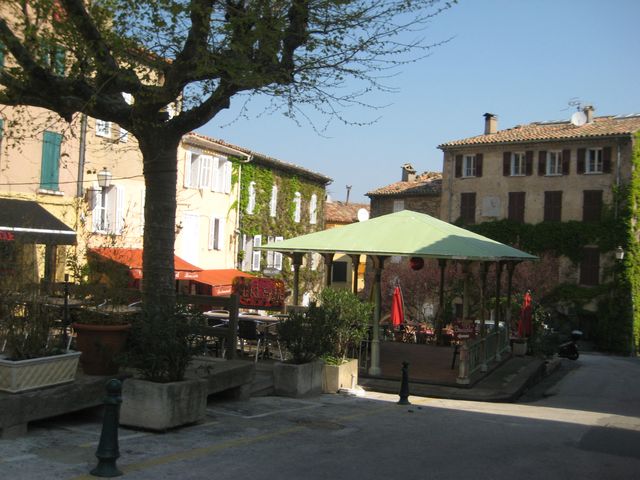
The present village, set lower down, keeps that memory in its name, its paths and a local culture strongly attached to relief. Paved lanes, passages, stone houses and the orientation table all prolong that permanent relation between settlement and height.
Fountains, chapels, mills and village life
The Fontaine Vieille, the washhouse, Saint-Jean chapel, the mills and several hamlets remind you that La Garde-Freinet organised itself around available water, paths and a long-dispersed rural life. In a country where water always mattered, fountains and springs are not decorative details; they were points of survival, work and social contact.
The village remains a genuinely lived centre, animated by squares, festivals, markets and shops, yet that animation keeps an inward scale. Heritage is discovered here less through a few large monuments than through a chain of modest landmarks linked by slope, stone and daily use.
Geology, forest and Maures botany
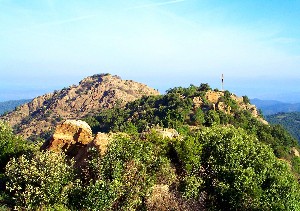
The relief here shows the physical material of the Maures very clearly. The Roches blanches owe their name to the quartz visible in the landscape. Slopes, lean soils, valleys and wooded sectors give the territory a roughness that differs sharply from the shoreline. Geology is never abstract; it shapes paths, viewpoints and use.
Botany follows that base: chestnut trees, cork oaks, scrub, fig trees, restored beehives, cooler undergrowth in places and dry vegetation on the ridges. This diversity makes the commune highly sensitive to season, forest scents, flowering and shifts in shade. You quickly understand that La Garde-Freinet reads as much through its flora as through its stone.
Local culture and rural economy
The identity of the village remains linked to cork, wood, slope cultivation, old herding routes and a hamlet life that left strong marks. The memory of forest work and small farms still accompanies the reading of the territory, even if the village now also lives through services, tourism and residence.
Local festivals, soupe au pistou, parish events, associations and workshops maintain an inland sociability very different from the harbour life of the gulf. This tone matters: La Garde-Freinet does not offer a mountain backdrop, but an active Provençal culture of relief.
How to approach it today
It helps to take time for the village itself and then gain a viewpoint or a carefully chosen path: Fort Freinet, Saint-Clement, Peygros, Les Roches blanches or one of the hamlet routes. This movement between centre and forest reveals the commune in its real rhythm.
Outside summer, the reading grows even better. The scents of cork, damp soil or chestnut come forward, the views clear and it becomes easier to see how heritage, geology and botany hold the landscape together.