







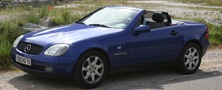
Restoration of our Mercedes SLK 230 Kompressor: diagnosis and reconditioning
Bought in Brittany in May 2025, our Mercedes SLK 230 Kompressor did not head straight for the Gulf of Saint-Tropez. At the time of purchase, the battery and wiper blades were replaced on site, then the car was taken directly to Garage SAVA in Rioz for the necessary repairs.
Road noise, a propshaft thumping under acceleration, tired front suspension, cracked front tyres and an older roof-hydraulic leak meant the car needed more than a tidy-up. It only reached the Gulf once it had become safe and properly usable again.
Key facts. Bought in Brittany in May 2025. Battery and wiper blades replaced on site. Failed propshaft centre bearing, failed right lower wishbone ball joint and cracked front tyres. At Garage SAVA: engine oil change, air and oil filters, replacement of the propshaft centre bearing and the right lower ball joint, headliner work after a leaking hydraulic hose, and two used front tyres fitted.
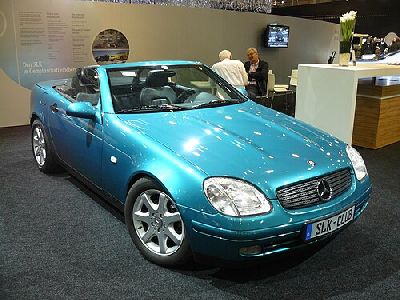
May 2025, bought in Brittany and taken straight to Rioz
When we bought the SLK in Brittany in May 2025, the car still started, moved under its own power and could be driven. Even so, that first impression was misleading. The car was bought as it stood, with known issues, but without the kind of deep inspection that would immediately show how serious each one really was.
The first jobs were carried out on site at the time of purchase: the battery was replaced, new wiper blades were fitted and the car was given a general clean. That was enough to prepare it for the trip to the workshop, not to call it sound. The car therefore did not go down to the Gulf of Saint-Tropez. It went straight to Garage SAVA in Rioz so it could be inspected and repaired before any normal use.
On the road the car was noisy. Under acceleration, the propshaft hit hard enough to force a very gentle driving style. The journey from Brittany to Garage SAVA was therefore made away from the motorway, precisely to avoid stressing an already doubtful driveline into a real breakdown. That detail says more than any general statement about the car's true condition at the time of purchase.
What the diagnosis really showed
The first value of the diagnosis was that it removed the vagueness. At this stage the engine appeared sound, but the rest of the running gear clearly required more serious work. The central issue was the propshaft centre bearing, a part that does more than create noise: once it develops play, vibrations rise, impacts travel through the floor and the risk of transmission damage eventually becomes real.
The front suspension also demanded priority attention. The failed right lower wishbone ball joint affects road holding, accelerates tyre wear and quickly turns a pleasant older car into an imprecise one. The roadworthiness inspection added a third warning, even more direct: the front tyres were cracked. Even if the car could still be driven, its safety base was no longer where it needed to be.
- Engine: judged sound during the first inspection.
- Transmission: degraded condition, with a failed propshaft centre bearing.
- Front end: degraded condition, with a failed right lower wishbone ball joint.
- Safety: critical at the start because of the running gear and tyres.
- Tyres: two cracked front tyres, later replaced with used tyres.
The technical report avoids any varnish. This is not a mere list of finishing jobs, but a car that first has to be made dependable again before it can feel relaxed on the road.
What has already been done at Garage SAVA
At Garage SAVA, the work went further than a basic service. The engine oil was changed, the air filter and oil filter were replaced, and the fuel filter was left alone because it was almost new. But the workshop also dealt with two much more important mechanical issues: replacing the right lower wishbone ball joint and replacing the propshaft centre bearing.
The roof required more specific attention. A leaking hydraulic hose had already been replaced by the previous owner, but the leak had left oil inside the headliner. The issue therefore did not stop at the hose itself. At SAVA, Laetitia removed and replaced the headliner to clear that lasting trace and put the interior back in order. On an SLK R170, this is no small side note: the electrohydraulic roof is one of the assemblies that must be watched closely if the car is to remain genuinely pleasant to own.
Two used front tyres were also fitted to give the car a safer rolling base while waiting for a deeper inspection of the rest. Taken together, those jobs already change the meaning of the car: the SLK is no longer just a purchase with known faults, it is gradually becoming usable again. Only at that point could it make its way to the Gulf of Saint-Tropez in proper safety.
Reconditioning rather than cosmetic restoration
What emerges from this first phase is not really the picture of an SLK that merely needed freshening up. It is the picture of a car that has to be brought back into shape methodically. The work started after the faults appeared, not before. In other words, the project is corrective before it is preventive. That often happens with a youngtimer that still looks usable, but has not been brought back into line as a whole.
The good news is that not every area was affected to the same degree. The engine was not listed among the immediate priorities. Once the roof leak had been dealt with and the interior repaired, the roof hydraulics did not look like a fully structural failure in themselves. By contrast, the transmission, front end and the broader safety check clearly had to come before long trips or any relaxed idea of use.
That hierarchy matters. On an SLK 230 Kompressor, driving pleasure comes from torque, compact size and the folding steel roof. If the chassis and driveline do not follow, the rest loses much of its meaning. Reconditioning is therefore not an extra layer of comfort. It is the condition required to recover the car as it ought to be.
The logical next steps
The action plan set after this first inspection is very coherent. On the transmission side, the flex disc, the full propshaft and its supports have to be checked, with preventive replacement if there is any doubt. At the front, the next logical stage involves ball joints, bushes, wishbones and a full alignment once the worn parts have been dealt with.
The roof also calls for continued attention: the remaining hoses, hydraulic pump and rams all need checking so that another leak does not damage the interior in turn. The overall service then has to go further than the first oil change and include the fluids that are often forgotten on a car of this age: brake fluid, coolant and gearbox oil, with spark plugs, coils and the auxiliary belt added according to actual wear.
Final validation cannot stop at a quiet idle in the workshop. It has to include a proper road test at SAVA, followed by a roadworthiness inspection consistent with the work performed. Only then can the SLK move from a car bought with known faults to a sound, dependable base that can genuinely be used for drives or more regular motoring.
That is the whole point of this restoration in the most useful sense of the word. The aim is not to make the car shinier than before. It is to give it back a proper road manner, restored safety and a roof that works without leaving traces inside. From that point on, the SLK becomes again what it does very well: an easy youngtimer, pleasant on the road and healthy enough to make you want to set off without second thoughts.
To place this reconditioning work within the story of our car, you can also read our Mercedes SLK in the Gulf of Saint-Tropez, along with the Mercedes-Benz SLK R170.
Sources
- Technical report and follow-up notes from the Les Caramagnols project, May 2025 and the work that followed.
- Use notes recorded on the Mercedes SLK 230 Kompressor before and after its time at Garage SAVA.
