

Panhard Dyna: light French engineering after the war
The Panhard Dyna name covers more than one car. It runs from the compact Dyna X of the late 1940s to the broader Dyna Z of the 1950s, with the same thread throughout: low weight, careful aerodynamics and a small engine asked to work intelligently.
The Dyna family matters because it shows a distinct French route after the war: a lighter car, a modest air-cooled flat twin and a body shaped to reduce waste rather than simply add power.
A new start after the war
In 1946, Panhard chose a different path from the large pre-war cars that had built its reputation. France needed simple, economical transport, but Panhard did not answer that need with a plain utility car. With engineer Jean-Albert Grégoire's ideas in the background, the Dyna X was designed around lightness, front-wheel drive and an air-cooled flat-twin engine.
The first cars used aluminium panels at a time when the material was still available from wartime stocks. The result was a small saloon with modest power, but a very favourable weight. Its 610 cc twin-cylinder engine was not impressive in isolation. In a light, well organised car, however, it gave useful performance, restrained fuel consumption and a character that no ordinary four-cylinder saloon could copy.
The logic of the Dyna X
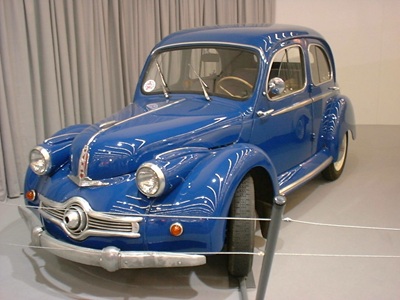
The Dyna X looked rounded, compact and slightly unusual even in its own period. Its shape was not only a matter of style. Panhard was already trying to reduce drag, to make better use of every horsepower and to keep the car pleasant on ordinary roads. The central structure, the independent suspension and the front-wheel-drive layout all served that same purpose.
Inside, the Dyna X offered more room than its size suggested. A flat floor, simple controls and good visibility made it a practical family car. It was also a car that asked the driver to understand it a little: the engine note, the light body and the particular controls gave it a personality that was mechanical rather than decorative.
Dynavia, the experimental line
The 1948 Dynavia prototype pushed the aerodynamic idea much further. Based on Dyna X components, it used a streamlined aluminium body and explored how far shape could reduce fuel consumption. It was not a production model in the usual sense, but it made visible the questions Panhard was already asking: how can a small engine move a car quickly, cleanly and with less effort?
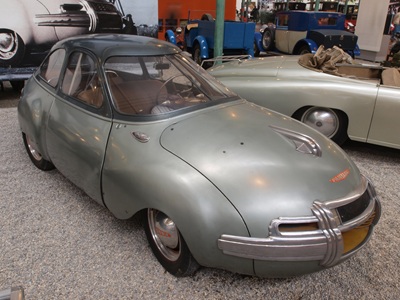
This is why the Dynavia still belongs naturally in the Dyna story. It shows the research behind the road cars. Panhard was not simply making light cars because materials were scarce. The company was turning lightness, airflow and efficiency into a coherent engineering method.
From Dyna X to Dyna Z
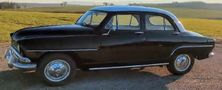
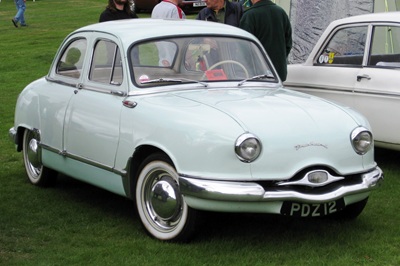
By 1954, the Dyna Z replaced the Dyna X with a larger and more comfortable body. The family resemblance remained clear, but the ambition changed scale. The new car was a real saloon, with a 851 cc flat twin, front-wheel drive, generous interior space and a body carefully drawn by Louis Bionier.
The earliest Dyna Z examples used Duralinox, an aluminium alloy that kept the weight low for a car of this size. That choice gave the model much of its liveliness, but it was expensive to manufacture. Panhard gradually moved to mixed construction and then to steel. The car became heavier, yet the core idea survived: make the whole car efficient before asking the engine to do more.
An original place in French motoring
The Dyna did not follow the same road as the high-volume Renault, Peugeot or Simca saloons of its time. It had its own grammar: an air-cooled flat twin, a very recognisable sound, a rounded body, front-wheel drive and a constant concern for weight. That made it both clever and demanding. A well-kept Dyna rewards a driver who accepts its rhythm and its technical habits.
The Dyna Z gave way to the PL 17, and Panhard's independence gradually narrowed before Citroën took full control. Yet the Dyna name keeps a strong place among enthusiasts because it represents a real engineering culture. It is not only a memory of the 1950s. It is a reminder that a family car can be designed from efficiency, restraint and precision.
What remains today
Today, the Dyna attracts collectors who like cars with a clear idea behind them. A Dyna X speaks of post-war reconstruction and technical economy. A Dyna Z speaks of ambition, space and aerodynamic work. Both show the same Panhard instinct: avoid unnecessary mass, make every part count and let a modest engine do more than expected.
That is why the Dyna still deserves more than a nostalgic glance. It is a small chapter of French automotive history, but a dense one, full of choices that remain interesting when the car is examined closely.
To place the Dyna Z in context, you can also read our Dyna Z12 in the Gulf of Saint-Tropez, along with the collectible Panhard Dyna Z.