
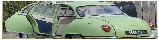
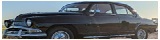
THE ARONDE FROM SIMCA

The Aronde, whose name evokes a swallow in old French, illustrates an innovative approach to automotive design. The choice of this name was not insignificant: it symbolized the vehicle's energy efficiency. The name refers to the bird's lightness and agility, suggesting economical fuel consumption. This ornithological metaphor conveys the manufacturer's commitment to developing a high-performance and fuel-efficient vehicle, reflecting the popular saying that associates the swallow with a "bird's appetite," that is, modest and rational.
The Aronde Swallow

The History of the Simca Aronde: The Star of the French Road

A Promising Birth

In the 1950s, France was emerging from a tumultuous period, and the need for innovation was felt. It was in this context that Simca, a major player in the French automotive industry, unveiled its masterpiece: the Simca Aronde.
Simca wanted to stand out from Fiat by offering a 100% French car, modern and adapted to the needs of the time, and for the first time in 1951, this innovative sedan was presented, which quickly became a symbol of modernity and elegance on French roads.
It immediately captivated the public thanks to its modern design and its performance, which surpassed those of many competitors. It was equipped with a 1.2-liter Flash engine developing 45 horsepower, offering a maximum speed of 120 km/h, which was remarkable for a car in its category at the time.

Innovative features:

- A monocoque body, lighter and more robust.
- A meticulous finish, positioning the car as an elegant but accessible model.
- Moderate fuel consumption, adapted to a period when the economy was still fragile after the war.

Simca aronde 9


The Aronde stands out for its airy design, its soft curves, and its streamlined silhouette that recalls the graceful flight of a swallow. This name, which means "swallow" in old French, confirms Simca's intention to combine lightness and fluidity, both in aesthetics and in driving.
The brand did not just create a car; it designed a real lifestyle, an invitation to explore the roads of France with freedom and confidence.

The Rise of an Automotive Monarch

In a few years, the Simca Aronde won the hearts of the French, and its success was not limited to sales. It embodied the spirit of a time when the automobile became a consumer good for everyone.
This sedan, appreciated for its comfort and reliability, was found in households and families from all walks of life. Beyond its utilitarian role, the Aronde symbolized the richness of a certain French art of living.

Evolution of the Aronde

The Aronde came in several versions, adapting its features to satisfy the different desires of drivers. Models such as the Aronde Grand Large, with its generous interior space, or the Aronde Sport, which offered a more dynamic driving experience, bear witness to the diversity of needs.
Following market fluctuations, Simca always remained attentive to integrating innovations, thus keeping the flame alive in the hearts of motorists.

Each version brought technical and aesthetic improvements:

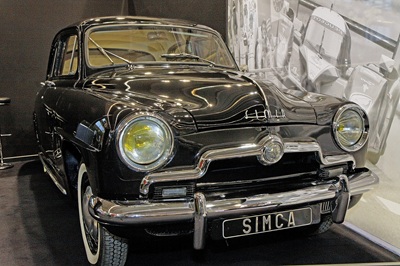
Aronde 9 (1951-1955):

The Aronde 9 marked Simca's debut in the modern sedan segment with a bold and elegant proposal. This model, launched in 1951, was both innovative and refined, representing a technological and stylistic leap forward for its time.

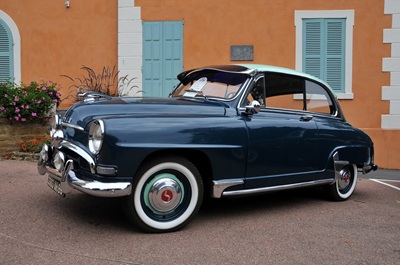
Simca Aronde Grand Large

Technical characteristics and performance

The Aronde was designed on a monocoque body, a modern choice that gave it lightness and robustness. Four meters long, it offered a spacious 200-liter trunk, enough to comfortably transport four passengers and their luggage.
Under the hood, there was a 4-cylinder engine of 1220 cm³ developing 45 horsepower. Coupled with a 4-speed manual gearbox, 3 of which were synchronized, this engine allowed the Aronde to reach a maximum speed of 125 km/h. Thanks to its dynamic acceleration and good road holding, it established itself as a pleasant and powerful car for its time.

A success from its launch

Presented at the 1951 Motor Show, the Aronde caused a sensation with its tiered grille and luxurious finish. Despite a high price of 675,000 francs, it immediately captivated with its fluid appearance and meticulous design.
In 1953, Simca expanded its offer with a more stripped-down version, called "Quotidienne" (Daily), intended for an audience looking for an affordable but reliable car.

Evolutions and improvements

Henri-Théodore Pigozzi, the visionary at the head of Simca, understood the importance of constantly evolving models to boost sales. The Aronde therefore underwent several improvements throughout its career:
- 1954: A first important update saw the grille soften for a more elegant design. The rear lights were now made of translucent plastic, improving safety and aesthetics.
- 1955: The wheels were reduced from 15 to 14 inches, with smaller hubcaps, and mechanical optimizations strengthened safety and driving pleasure. This version was named "Surbaissée 55" (Lowered 55).

For the 1954 and 1955 model years, the Aronde was offered in two main finishes:
Quotidienne: a simplified version for modest budgets.
Luxe: a more sophisticated finish, with options like white-wall tires, very popular at the time.

Aronde 1300 (1955-1958):

The "Ligne Océane": A new era for the Aronde

For the 1956 model year, Simca carried out a deep transformation of the Aronde, in line with the brand's policy of constant evolution. The "Ligne Océane" (Ocean Line) introduced notable modifications both mechanically and aesthetically, while remaining true to the innovative spirit that made the range successful.

Design: American inspiration and French elegance

The 1956 model had a completely renewed look.
- Front: A new, more angular grille gave the car a strong character.
- Rear: Fins, inspired by American fashion, brought a touch of modernity and dynamism.
- Interior: The dashboard, steering wheel, and seats were completely redesigned, reflecting an increased concern for comfort and elegance.

Simca aronde convertible

Improved performance and mechanics

- The engine underwent a major overhaul and adopted the name "Flash".
- Displacement: Increased to 1290 cm³, giving rise to the name Aronde 1300.
- Power: Now 48 hp SAE, offering a slightly higher top speed of 130 km/h.
- Handling: The engine was distinguished by its power accessible from low speeds, making driving more pleasant and flexible.

An extended and customizable range

The "Ligne Océane" offered different versions adapted to customer expectations:
Deluxe: The entry-level version, simple and affordable.
Elysée: A better-equipped finish, offering superior comfort.

Simca aronde A90 Elysée

In 1957, Simca introduced a top-of-the-range version:

- Elysée-Matignon: Featuring a customizable two-tone paint and a host of new equipment. Its power was slightly increased, allowing it to reach 140 km/h. However, this version, deemed too sophisticated, met with mixed success.

Records and innovations for the 1958 model year

In April-May 1957, an Aronde set a remarkable feat by breaking more than 40 world or international records on the Montlhéry ring.
In tribute to this feat, Simca launched a new version in 1958:
- Monthléry: This variant replaced the Elysée-Matignon. Equipped with the 57 hp Flash engine, it combined performance and fuel efficiency.

Monthléry world record plaque


Advanced options: The Monthléry and Elysée models could be equipped with Simcamatic, an innovative automatic clutch, although slightly exaggerated in its name.

A commemorative plaque

The 1958 models sported a distinctive plaque on their trunk lid celebrating the world records, highlighting the excellence and international reputation of the Aronde range.

The Aronde P60 (1958-1963): A significant evolution


The Aronde P60 represented the pinnacle of the Aronde range, with stylistic and technical innovations adapted to the growing expectations of consumers in the 60s. This model reflected a desire for modernity, both in its design and its performance.

A new identity

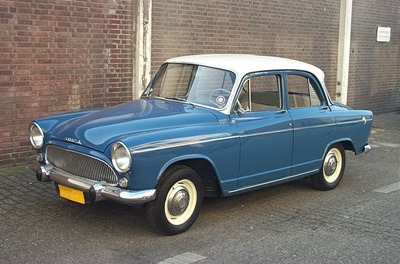
Presented at the 1958 Motor Show, the P60 owed its name to a visionary idea from Henri-Théodore Pigozzi: "P" for personalized, and "60" to symbolize a technological and aesthetic lead for the coming decade. This version marked a visual break thanks to a more angular design, a flat roof with a visor overhanging a larger rear window, and resolutely modern lines.

Mechanical innovations and range diversity

The 1290 cm³ Flash engine (48 hp) remained faithful for the first Elysée finishes, but the 1959 model year introduced important improvements: a revisited rear suspension combining leaf and coil springs, and the arrival of a top-of-the-range version, the Monthléry, equipped with a 60 hp engine allowing it to reach 140 km/h.
In 1961, the range received a new five-bearing engine named "Rush", offering better robustness and increased performance. The Monthléry then evolved into the Monthléry Spéciale, with 70 hp, while other models, such as the Etoile 6 and 7, met the needs of customers looking for more affordable cars.

Anecdotes and rarities

At the beginning of 1958, an experimental series of 700 "hybrid" P60s was produced with a curved roof, the absence of a rear visor, and unusual three-part bumpers. Pigozzi's reaction to this discovery was extremely negative and he ordered the immediate withdrawal of this series. The 700 cars were stored in Bordeaux, on the Quai de Bacalan, from which they get their nickname. They were later sold in Eastern European countries, often used as taxis.

Simca Aronde P60

The arrival of the Simca 1000 and the end of an era

With the introduction of the Simca 1000 in 1962, the Aronde began to lose its relevance in the face of growing competition. The gradual abandonment of the P60 name marked the transition to a new era for Simca.

A popular success

The Aronde was a huge commercial success. More than 1.4 million units were sold, making it one of the most popular cars in France in the 1950s and 1960s. It was particularly appreciated for:


Its competitive price.
Its reliability and robustness.
Its aesthetics, which made it desirable both in the city and for rural journeys.
The Aronde also had an international career, being exported to Europe, America, and even Africa.

End of the Aronde

In 1963, the production of the Aronde ceased to make way for the Simca 1300/1500, a more modern model. However, the Aronde remains an icon of its time, symbolizing the rise of the French automotive industry in the post-war period.

A Lasting Legacy

Despite the end of its production in 1963, the legacy of the Simca Aronde endures. This automobile is not just a memory; it has become part of French automotive heritage.
Enthusiasts regularly gather at meetings dedicated to this iconic car, sharing anecdotes, restoration tips, and travel stories.

Today, the Aronde is the subject of meticulous restorations by fervent amateurs. Each of these restored cars tells a unique story, mixing nostalgia and passion. At classic car rallies, the Aronde often attracts attention, sparking smiles and animated discussions.
It reminds everyone that behind every automobile lies memories, dreams, and a bit of history.

Conclusion: The Essential Simca Aronde

The Simca Aronde is not just a simple car; it is an icon, a symbol of a time when the automobile was both a symbol of independence and progress. It knew how to capture the essence of post-war France, a time when beauty and functionality blended harmoniously. Its name, like a swallow's song in spring, recalls lightness and the promise of a radiant future.

Thus, the Simca Aronde continues to inspire and amaze, proving that true icons do not obey the limits of time. If you ever cross an Aronde on your path, know that you are not simply crossing a car; you are discovering a piece of the history of the French automobile, a vehicle that embodied the spirit and determination of an era.