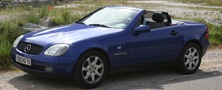




Mercedes-Benz SLK R170, the first compact Mercedes roadster with a folding steel roof
Key facts: 1994 studies, production from 1996 to 2004, 25-second vario-roof, 348-litre boot with the roof up and 145 litres open, 311,222 cars sold.
The SLK R170 holds a very specific place in recent Mercedes-Benz history. Presented in production form in spring 1996 and built until 2004, it was the first car to carry the SLK name and the one that made the small folding-hardtop roadster a familiar idea rather than a motor-show curiosity. Its success came less from fashion than from the precision of its brief.
Mercedes was not simply putting another compact cabriolet into the catalogue. The brand wanted a car that could behave like a serious small coupe with the roof closed, then open up without giving up everyday usefulness. That very concrete promise, even more than the shape of the body, explains why the R170 remains the defining generation of the SLK family.
1994-1996: a study that was almost ready for production
Before sales began, Mercedes first showed a very advanced study in spring 1994, then a second version at the Paris Motor Show in October 1994. That Paris car really fixed the image of the future model: short proportions, a tidy rear end, twin hoops behind the seats and, above all, a steel vario-roof able to disappear into the boot in 25 seconds.
The important point was not only the showmanship of the mechanism. The boot still kept enough room for luggage, and that changed the nature of the car. The SLK was not promising a fair-weather toy. It was introducing something more complete, able to move from closed to open use without becoming purely decorative.
The name SLK summed up the intention: Sportlich, Leicht, Kurz, or sporty, light and short. At Mercedes that did not mean stripped out. The future R170 still had to feel like a proper car from the brand in the way it handled safety, finish quality and long-distance use, even if its footprint was much tighter than that of an SL.
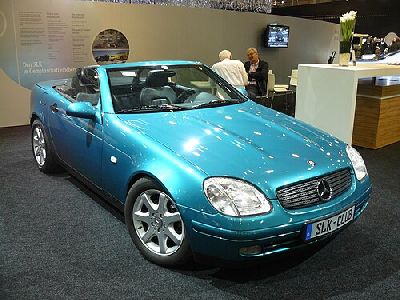
A small roadster, but engineered the Mercedes way
Once launched, the R170 kept that logic perfectly clear. Two seats, rear-wheel drive, a short wheelbase, a firmly planted windscreen, fixed roll-over bars and a steel roof: everything was organised around a straightforward use case. Closed, the car insulated properly and looked like a compact coupe. Open, it recovered the direct pleasure of a roadster without the larger compromises of a fabric hood.
The structure was taken seriously. Mercedes highlighted thick-walled steel roll-over bars, reinforced windscreen pillars, front airbags, belt tensioners and optional sidebags. The front end also introduced an ellipsoid bulkhead designed to preserve footwell space more effectively in a frontal crash. Even on a leisure model, the company refused any lightweight engineering in the cheap sense of the term.
The work on weight and usability also mattered. Some parts used magnesium, the base version came in at about 1,270 kg, the SLK 200 reached a drag coefficient of 0.33 and the boot offered 348 litres with the roof up, still 145 litres with it folded away. For the late 1990s, that was a remarkable combination: the R170 remained compact without ruling out a weekend away or a genuinely useful trip.
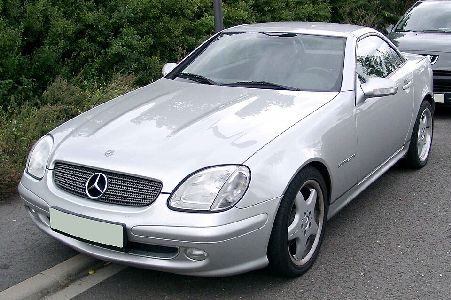
SLK 200, 230 Kompressor, then the 2000 facelift
At launch in Germany, the range relied on the naturally aspirated 136 hp SLK 200 and, above all, on the 193 hp SLK 230 Kompressor. The latter gave the model its most convincing tone. With 280 Nm available low in the rev range, it matched the spirit of the car: strong in-gear response, compact dimensions and an appeal based more on torque than on aggression.
The sales figures confirm it. Across the full R170 career, Mercedes sold 311,222 cars, and the most popular version was the early SLK 230 Kompressor, built in 113,520 units. The SLK therefore did not remain a glamorous niche object. It found a broad enough audience to justify a career lasting nearly eight years.
The spring 2000 facelift strengthened the formula again. The lines became slightly tenser, the bumpers and side skirts were revised, while ESP, the six-speed manual gearbox and SPEEDTRONIC cruise control became standard equipment. The range then widened with the SLK 320 V6 and later the SLK 32 AMG. At the end of production, the Final Edition closed a chapter that had already become solidly established.
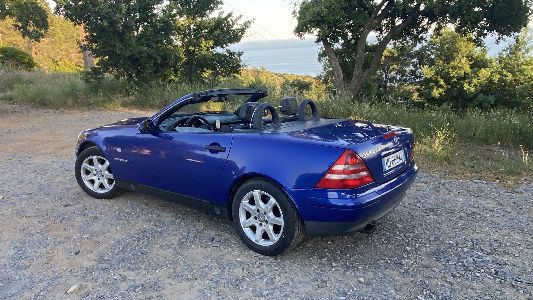
Why the R170 still deserves attention today
The R170 is not the most powerful SLK and not the most refined one either. It is not the sharpest choice if you want a pure sports roadster. But it is the clearest generation in its original idea. The design remains simple, the compact footprint still works well on real roads, and the two-tone cabin with ringed instruments still tells the story of late-1990s Mercedes very effectively.
It is also the SLK that explains all the others. Without this first generation there would have been no more mature R171 and no R172 that later became the SLC. To place the R170 within the broader line, you can read our page on the history of the Mercedes-Benz SLK. And to see what this model feels like in real family use, it is worth looking at our 1996 SLK 230 Kompressor in the Gulf of Saint-Tropez.
The first SLK ultimately left behind a simple but durable idea: a compact roadster can remain desirable if it does not force its driver to choose all the time between pleasure, protection and real use. On that precise point, the R170 got it right, which is why it still matters today.
To place the SLK in context, you can also read our Mercedes SLK in the Gulf of Saint-Tropez, along with the Mercedes-Benz SLK story.