




Renault Twingo: the story of a city car that lasted
Revealed in 1992 and launched in 1993, the Renault Twingo put ingenuity and everyday flexibility back at the centre of the European city car. Its one-box body, sliding rear bench and deliberately simple launch made it easy to understand from the beginning. That practical accuracy, more than fashion alone, explains why the model stayed around for so long.

1992-1993: a small Renault that went against the grain
In 1992 Renault surprised the market with a car that looked both simple and unexpected. Developed under project director Yves Dubreil and designed by Jean-Pierre Ploué, the Twingo reached showrooms in 1993 with a deliberately narrow offer: one engine, one price and four launch colours. That stripped-back formula was not a weakness. It made the car easy to understand from the start.
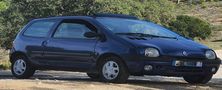
The Twingo did not try to imitate a conventional small hatchback. Its one-box silhouette, short front end and almost smiling face gave it a fresh presence at the beginning of the 1990s. Renault brought a sense of freedom back to a segment that had become rather sober, while still staying firmly rooted in everyday use.
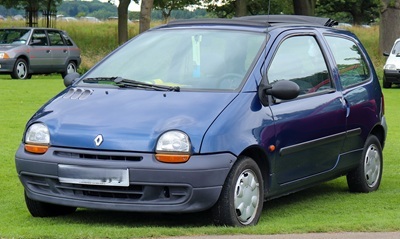
The 1993 launch also mattered because it kept a light tone without losing sight of practical seriousness. Its name, built from Twist, Swing and Tango, already suggested a car made for mobile urban lives rather than for formal status. That mix of clarity and playfulness is what allowed it to settle so quickly into the landscape.
Short on the outside, but designed to feel roomy inside
At 3.43 metres long, the first Twingo was undeniably a small car. Yet its one-box body and wheels pushed to the corners freed up far more cabin space than its size suggested. This is where the model became genuinely interesting: not through a dramatic specification sheet, but through the intelligence of its layout.
The sliding and tilting rear bench, the seats that could turn into makeshift beds and the tall cabin all followed the same idea. Renault was not simply trying to fit passengers into a small shell. It was trying to make the car easier to live with, whether the day involved shopping, bags, children or short weekend journeys. A large part of the Twingo's long afterlife comes from that flexibility.
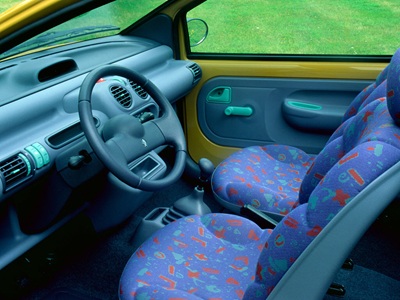
That also explains the car's place in ordinary memory. The Twingo was not only seen in advertising or in city-centre car parks. It served simple, repeated tasks: commuting, taking children to school, carrying a bit more than expected and fitting into places where larger cars did not.
A long-running first generation with bright colours and real reach
The success of the Twingo I did not stop with the novelty of its early years. Renault kept it alive, revised it and added many limited editions such as Benetton, Kenzo, Perrier and Elite. The model stayed recognisable through all these variations, which is no small achievement over such a long career.
Its wide circulation says a lot about its success. According to Renault's own heritage documentation, the first generation was produced in 2,444,455 units. That makes it much more than a charming idea from the 1990s. It was a large-scale production car that genuinely occupied the street for years.
That longevity came from a rather rare balance. The Twingo kept a playful face, but it never turned into a fashion accessory alone. It lasted because it combined a strong design, real cabin usefulness and running costs that still matched ordinary everyday life.
From Twingo II to Twingo III, the formula changed without vanishing
In 2007 Renault launched the Twingo II. The shape became more conventional and the car took on a sportier tone with Gordini and then R.S. versions. The model changed with its era, yet it kept its primary role: to remain a small urban car that was easy to live with and broad enough in appeal not to become niche.
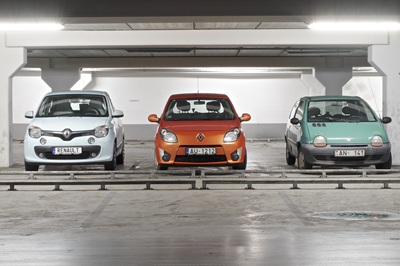
In 2014 the Twingo III introduced a sharper break with the return of a rear-mounted engine. Renault brought back an architecture that had become unusual in this segment and recovered a very tight turning circle, something drivers could immediately feel in narrow streets and repeated manoeuvres. The point was not to copy the 1993 car exactly, but to recover its agility in a new way.
The third generation proved that the Twingo could change its recipe without losing its character entirely. What remained constant was the search for a practical, slightly mischievous small car whose value is measured above all in day-to-day use rather than in grand claims.
Why the Twingo still feels familiar
The Twingo mattered because it answered very concrete situations. People knew it as a first car, a second household car, or a small Renault that made short journeys and tight parking easy. These are modest uses, but they count for more than any large advertising story.
Renault has also kept the name alive. After the arrival of Twingo Electric in 2020, the brand opened the first orders for a new Twingo E-Tech electric in December 2025, ahead of a broader market launch in 2026. That continuity shows that the original idea has not run out of value: a small urban car can still be welcoming, modular and accessible if its design genuinely begins with everyday needs.
More than thirty years after the 1993 launch, the Twingo therefore remains less an abstract icon than a very concrete marker in European motoring. It reminds us that a successful city car does not need to overstate itself. A good idea, clearly held, is often enough to last.
To place the Twingo in context, you can also read our Twingo Hélios in the Gulf of Saint-Tropez, along with the history of Renault.